
La Bibliothèque d'Applications présente des modèles construits avec COMSOL Multiphysics pour la simulation d'une grande variété d'applications, dans les domaines de l'électromagnétisme, de la mécanique des solides, de la mécanique des fluides et de la chimie. Vous pouvez télécharger ces modèles résolus avec leur documentation détaillée, comprenant les instructions de construction pas-à-pas, et vous en servir comme point de départ de votre travail de simulation. Utilisez l'outil de recherche rapide pour trouver les modèles et applications correspondant à votre domaine d'intérêt. Notez que de nombreux exemples présentés ici sont également accessibles via la Bibliothèques d'Applications intégrée au logiciel COMSOL Multiphysics® et disponible à partir du menu Fichier.
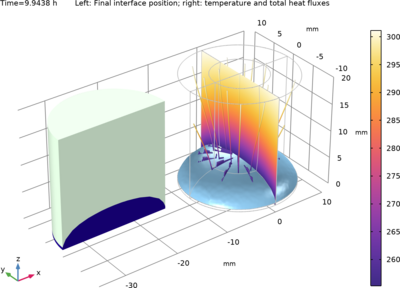
Freeze-drying, or lyophilization, is a process for drying heat-sensitive substances such as foods, blood plasma, and antibiotics. The wet substance is frozen and then, through sublimation, ice (or some other frozen solvent) is removed in the presence of a high vacuum. This example ... En savoir plus
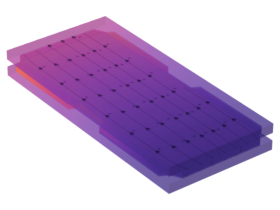
This tutorial models the thermal management of a polymer electrolyte membrane (PEM) fuel cell stack. Operating the stack with a similar temperature profile for all cells is important since an uneven temperature distribution may otherwise result in nonuniform water vapor condensation and ... En savoir plus
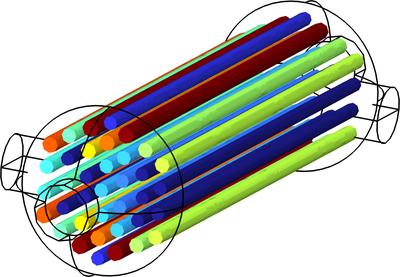
Commercial heat exchangers often feature a complex design. It is significantly easier to build a design with new CAD parameters than to build designs with novel topologies. This model demonstrate how to optimize the size and position of the tubes in a tube and shell heat exchanger. It is ... En savoir plus
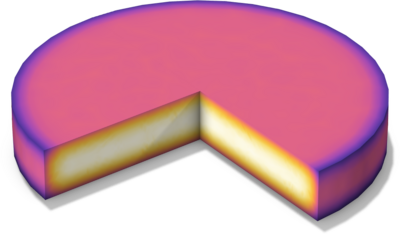
The purpose of this model is to introduce the Semitransparent Surface Feature from the Radiation in Participating Media Interface. It is a variation of the Radiative Cooling of a Glass Plate model with the DOM method. In this version a semitransparent surface is defined on external ... En savoir plus
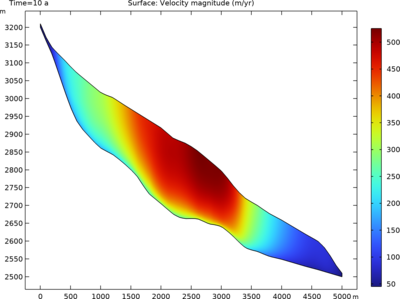
This example shows how to set up a glacier flow model in principle, containing several important aspects of glacier modeling: The creation of the 2D geometry, the modeling of non-Newtonian flow, and the implementation of basal sliding. In this example, two different glacier types, a cold ... En savoir plus
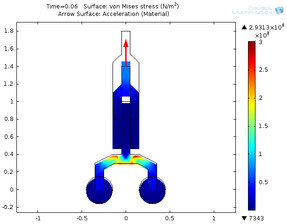
This model simulates the dynamics of the shock absorber used in a landing gear mechanism of an aircraft. It analyses the stresses, as well as the heat generated in the landing gear components due to the energy dissipated in the shock absorber. A prismatic joint, with spring and damper, ... En savoir plus
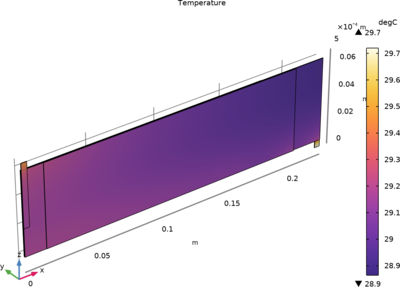
This example replicates the results of the Jelly Roll tutorial example using a flattened representation of the wound spiral-based geometry. See that model entry for details on the background, original geometry, materials, and the general physics setup. Mapping the original problem to a ... En savoir plus
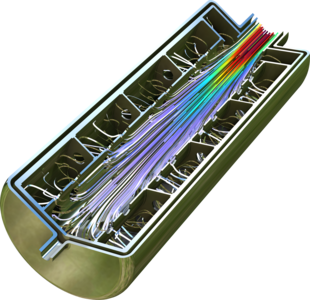
Metal hydride tanks offer safe hydrogen storage, thanks to their low reactivity, and a relatively high hydrogen density. When developing metal hydride hydrogen tank designs, modeling and simulation is useful for optimizing operating conditions, such as gas composition, pressure, and ... En savoir plus

In this model, we show how to model Seebeck effect which works as a thermoelectric generator. Seebeck effect is a phenomena where the difference in temperature of a material leads to a potential difference. The potential drawn in this model was compared with the paper by Jaegle (Example ... En savoir plus
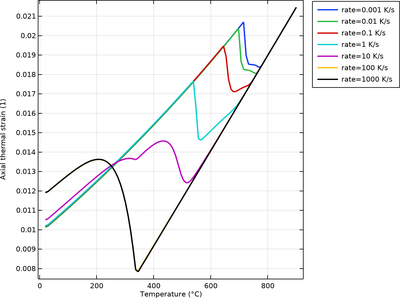
In this example, phase transformation data and phase material properties are imported from JMatPro, and used to compute CCT curves. Dilatometry curves (axial thermal strain) are computed across a range of cooling rates. En savoir plus