
La Bibliothèque d'Applications présente des modèles construits avec COMSOL Multiphysics pour la simulation d'une grande variété d'applications, dans les domaines de l'électromagnétisme, de la mécanique des solides, de la mécanique des fluides et de la chimie. Vous pouvez télécharger ces modèles résolus avec leur documentation détaillée, comprenant les instructions de construction pas-à-pas, et vous en servir comme point de départ de votre travail de simulation. Utilisez l'outil de recherche rapide pour trouver les modèles et applications correspondant à votre domaine d'intérêt. Notez que de nombreux exemples présentés ici sont également accessibles via la Bibliothèques d'Applications intégrée au logiciel COMSOL Multiphysics® et disponible à partir du menu Fichier.
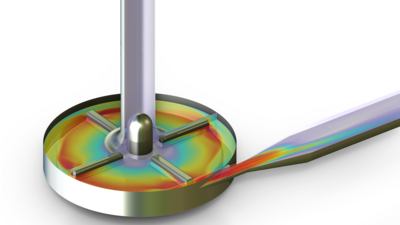
In this benchmark model for blood flow in a centrifugal pump, simulations are performed for several flow rates and pump speeds. The modeled geometry is taken from the FDA’s Computational Round Robin and the results are in good agreement with the experimental data. The computed shear ... En savoir plus
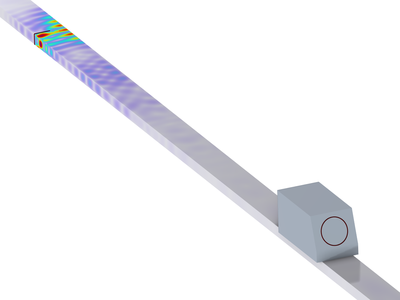
Numerical modeling of Lamb waves, which belong to guided waves, is essential for the analysis and design of the structural health monitoring (SHM) systems for long range ultrasonic testing. The design of an SHM system based on guided waves consists of two main parts. In the first place, ... En savoir plus
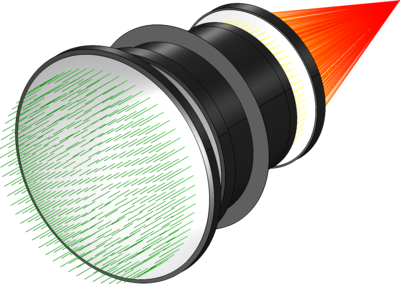
This tutorial shows how to set up a multi-element objective lens. The chosen lens is the Double Gauss described in 'Modern Lens Design (2nd edition)', by W. Smith, 2005, pg 323. The tutorial demonstrates how to create a geometry sequence using the 'Spherical Lens 3D' part found in the ... En savoir plus
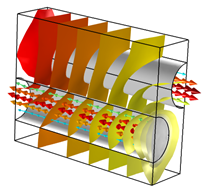
The example concerns a stainless-steel MEMS heat exchanger, which you can find in lab-on-a-chip devices in biotechnology and in microreactors such as for micro fuel cells. This model examines the heat exchanger in 3D, and it involves heat transfer through both convection and ... En savoir plus
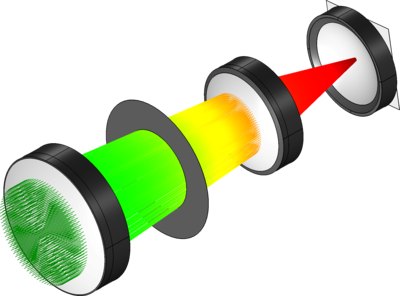
This tutorial shows how to set up a multi-element objective lens. The chosen lens is a Petzval lens with field flattener described in 'Fundamental Optical Design', by M. Kidger, 2001, pg 192. The tutorial demonstrates how to include a geometric sequence using the 'Spherical General Lens ... En savoir plus
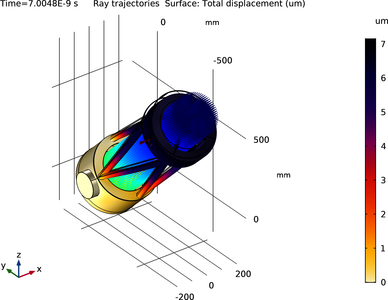
This tutorial demonstrates a structural analysis of a simple telescope. The deformation of the telescope structure under gravity is examined and the effect on image quality is demonstrated. En savoir plus
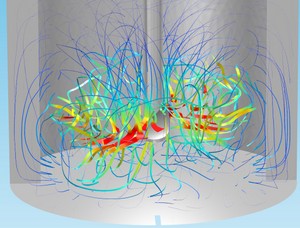
This model exemplifies the use of the Rotating Machinery interface, which allows you to model moving rotating parts in, for example, stirred tanks, mixers, and pumps. The Rotating Machinery interface formulates the Navier-Stokes equations in a rotating coordinate system. Parts that are ... En savoir plus
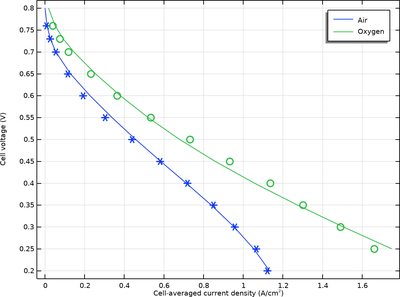
This tutorial demonstrates how to use stationary polarization data to perform parameter estimation of a polymer electrolyte membrane fuel cell (PEMFC) model. The model, defining a 5-layer membrane electrode assembly (MEA) is two-dimensional and includes electronic and ionic charge ... En savoir plus
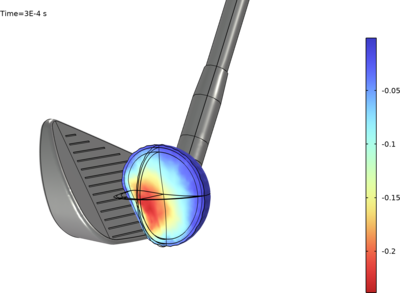
In this example, the mechanical impact of a golf club hitting a golf ball is studied. The contact between the two parts is modeled using a viscous penalty formulation to stabilize the dynamic event. To properly model the large deformation, the golf ball is defined using a hyperelastic ... En savoir plus
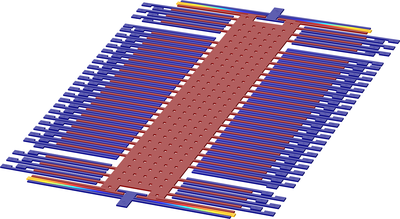
This model shows how to simulate a capacitively actuated surface micromachined accelerometer, using the Electromechanics Interface. It is based on a case study from the book Microsystem Design by Stephen D. Senturia (Kluwer Academic Publishers, 5th Edition, 2003, pages 513-525). En savoir plus