
La Bibliothèque d'Applications présente des modèles construits avec COMSOL Multiphysics pour la simulation d'une grande variété d'applications, dans les domaines de l'électromagnétisme, de la mécanique des solides, de la mécanique des fluides et de la chimie. Vous pouvez télécharger ces modèles résolus avec leur documentation détaillée, comprenant les instructions de construction pas-à-pas, et vous en servir comme point de départ de votre travail de simulation. Utilisez l'outil de recherche rapide pour trouver les modèles et applications correspondant à votre domaine d'intérêt. Notez que de nombreux exemples présentés ici sont également accessibles via la Bibliothèques d'Applications intégrée au logiciel COMSOL Multiphysics® et disponible à partir du menu Fichier.
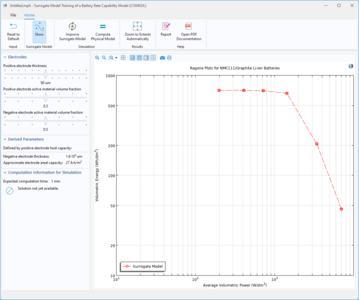
This app demonstrates the usage of a surrogate model function for predicting the rate capability of an NMC111/graphite battery cell. The rate capability is shown in a Ragone plot. The surrogate function, a Deep Neural Network, has been fitted to a subset of the possible input data ... En savoir plus
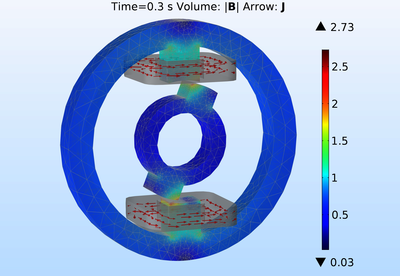
Switched reluctance motors work on the principle of reluctance torque. The stator and rotor will interact to minimize the reluctance for the flux path. This application simulates the behavior of the motor when the stator winding is excited with a step voltage and when the rotor is at a ... En savoir plus
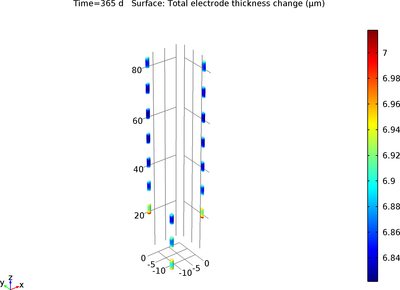
This model exemplifies how the rate of steel corrosion in an oil platform increases over time due to build-up of a resistive film on the sacrificial anodes, formed by reaction products. The model also includes secondary current distribution electrode kinetics on the protected steel ... En savoir plus
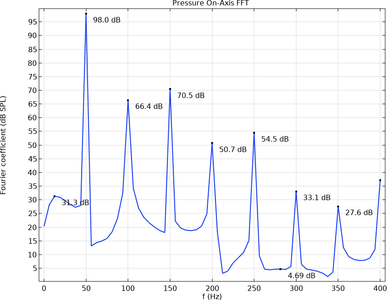
This model shows how to include the nonlinear (large signal) behavior of certain lumped components in a simplified loudspeaker analysis. The mechanical and electrical system is modeled using an equivalent electrical circuit. The large signal compliance CMS(x) and force factor BL(x) are ... En savoir plus
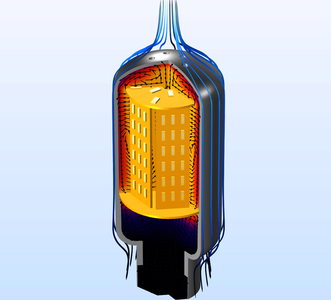
This model describes the three heat transfer modes: conduction, convection, and radiation, combined with nonisothermal flow in a realistic geometry representing a light bulb and the surrounding air. The LED chips dissipate heat. The model computes the equilibrium temperature induced by ... En savoir plus

The present model example is based on Copper Deposition in a Trench model available in Electrodeposition Application Library. The nonuniform deposition along the trench surface leads to formation of a cavity/void. Since the Deformed Geometry interface cannot handle topological changes, ... En savoir plus
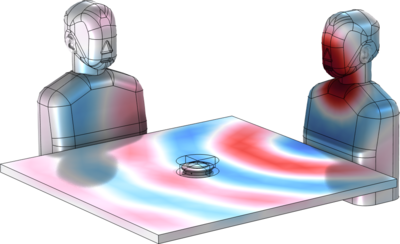
This tutorial model shows a virtual test setup of a conference speaker. The speaker system consists of a loudspeaker as well as three microphones. The model instigates the loudspeaker sound radiation, feedback, as well as the ability of the system to detect sound (speech) emitted from a ... En savoir plus
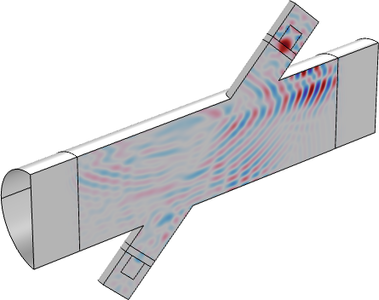
Ultrasonic flowmeters determine the velocity of a fluid flowing through a pipe by sending an ultrasonic signal across the flow at a skew angle. When there is no flow, the transmitting time between the transmitter and the receiver is the same for the signals sent in the upstream and ... En savoir plus
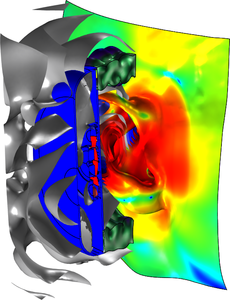
Headphones are closely coupled to the ear, and so it is not possible to measure their sensitivity in a classical acoustic free-field setup used for loudspeakers. The measurement requires the use of artificial heads and ears to accurately represent the usage conditions. This model shows ... En savoir plus
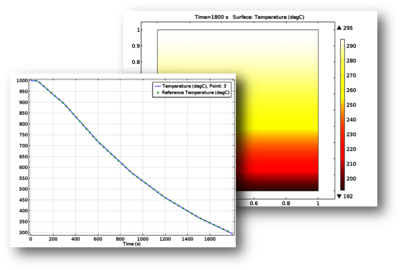
This entry is a compilation of some examples from DIN EN 1991-1-2 (Actions on structures exposed to fire). Models that are included: 1. Cooling (HT) 2. Heating (HT) 3. Heat transfer through multiple layers (HT) 4. Thermal elongation (SME, thermal stress) 5. Thermal expansion (SME, HT, ... En savoir plus