
La Bibliothèque d'Applications présente des modèles construits avec COMSOL Multiphysics pour la simulation d'une grande variété d'applications, dans les domaines de l'électromagnétisme, de la mécanique des solides, de la mécanique des fluides et de la chimie. Vous pouvez télécharger ces modèles résolus avec leur documentation détaillée, comprenant les instructions de construction pas-à-pas, et vous en servir comme point de départ de votre travail de simulation. Utilisez l'outil de recherche rapide pour trouver les modèles et applications correspondant à votre domaine d'intérêt. Notez que de nombreux exemples présentés ici sont également accessibles via la Bibliothèques d'Applications intégrée au logiciel COMSOL Multiphysics® et disponible à partir du menu Fichier.
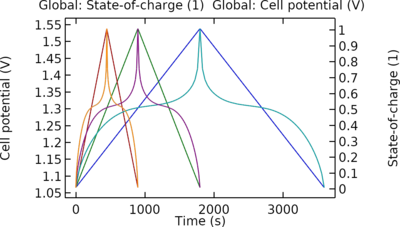
A simple equivalent circuit model approach is presented for Nickel metal hydride batteries. The 0D model consists of resistor, capacitor, current source and state-of-charge based voltage source (SOC). An Arrhenius type dependence is used to account for self-discharge. All model ... En savoir plus
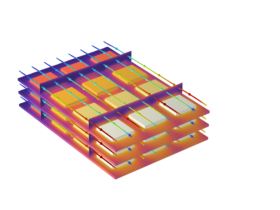
The suite of models examine the air cooling of circuit boards populated with multiple integrated circuits (ICs), which act as heat sources. Two possible cooling scenarios are depicted: vertically aligned boards using natural convection, and horizontal boards with forced convection (fan ... En savoir plus
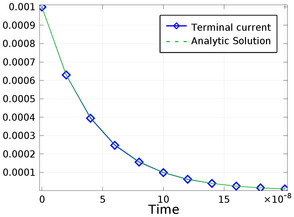
A transient model of a capacitor is solved in combination with an external electrical circuit. The finite element model of the capacitor is combined with a circuit model of a voltage source and a resistor. A step change in voltage is applied, and the transient current through the ... En savoir plus
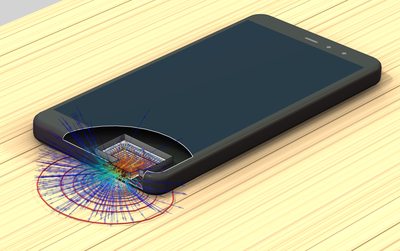
This tutorial model shows how to model a microspeaker located in a smart phone including the radiation through and interaction with the acoustic port that connects to the exterior. The model demonstrates a linear frequency domain analysis as well as a nonlinear time domain analysis. A ... En savoir plus

Small heating circuits find use in many applications. For example, in manufacturing processes, they heat up reactive fluids. The device in this tutorial consists of an electrically resistive layer deposited on a glass plate. The layer results in Joule heating when a voltage is applied to ... En savoir plus
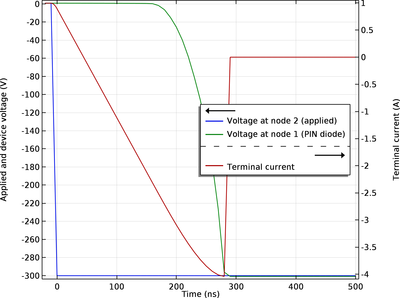
This tutorial simulates the turn-off transient (reverse recovery) of a simple PIN diode with an inductive load, loosely based on the book "Fundamentals of Power Semiconductor Devices" by B. J. Baliga (p. 256, 2008 edition). Unlike the book, which assumes an initial constant current ramp ... En savoir plus
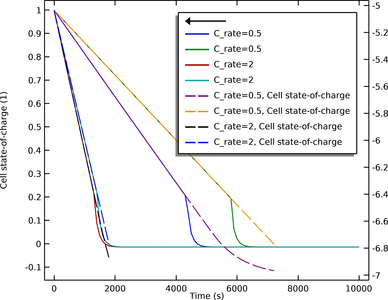
This tutorial demonstrates how to integrate multiple Lumped Battery models into the Electrical Circuit interface. Two batteries are connected in series. Each battery is protected by a shunt resistances that is activated if the battery state-of-charge reaches below a certain threshold ... En savoir plus
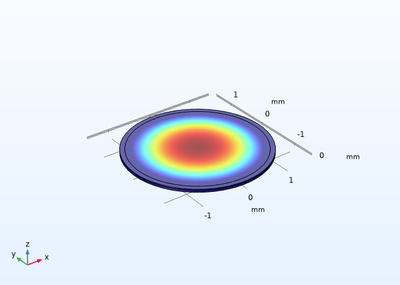
This 2D axisymmetric model demonstrates the operation of a pyroelectric detector found in instruments for measuring laser energy. A disk of lithium niobate (LiNbO3) is sandwiched between two electrodes and connected to an external circuit. The disk is mounted on a ring-shaped ... En savoir plus
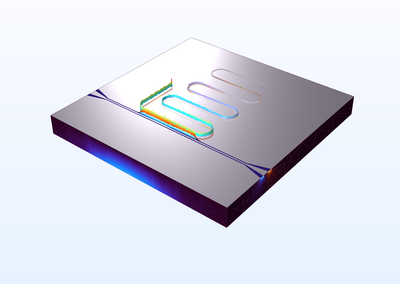
Developments in the last decade have made circuit quantum electrodynamics (cQED) the leading architecture for quantum computation. cQED is the solid-state version of cavity QED, which studies the basic light-matter interactions at the quantum level. This model examines one of the main ... En savoir plus
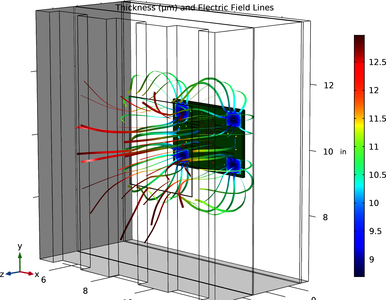
This example simulates electroplating of a printed circuit board (PCB) in 3D using the Secondary Current Distribution interface. In order to achieve thickness uniformity across the PCB, a dummy pattern is included in the design, along with an aperture in the electroplating bath. En savoir plus