
La Bibliothèque d'Applications présente des modèles construits avec COMSOL Multiphysics pour la simulation d'une grande variété d'applications, dans les domaines de l'électromagnétisme, de la mécanique des solides, de la mécanique des fluides et de la chimie. Vous pouvez télécharger ces modèles résolus avec leur documentation détaillée, comprenant les instructions de construction pas-à-pas, et vous en servir comme point de départ de votre travail de simulation. Utilisez l'outil de recherche rapide pour trouver les modèles et applications correspondant à votre domaine d'intérêt. Notez que de nombreux exemples présentés ici sont également accessibles via la Bibliothèques d'Applications intégrée au logiciel COMSOL Multiphysics® et disponible à partir du menu Fichier.
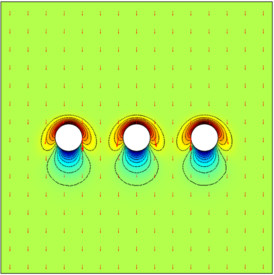
This example utilizes the Richards’ Equation interface to assess how well geophysical irrigation sensors see the true level of fluid saturation in variably saturated soils. The challenge to characterizing fluid movement in variably saturated porous media lies primarily in the need to ... En savoir plus
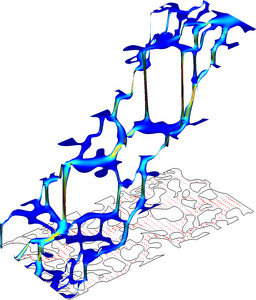
This non-conventional model of porous media flow utilizes creeping (Stokes) flow in the interstices of a porous media. The model comes from the pore-scale flow experiments conducted by Arturo Keller, Maria Auset, and Sanya Sirivithayapakorn of the University of California, Santa Barbara. ... En savoir plus
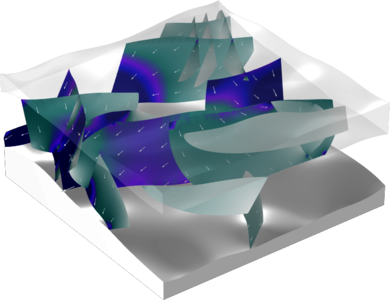
This model shows how to set up a simulation of flow through a fractured reservoir. The reservoir includes a discrete fracture network (DFN), where the fractures have a randomized distribution of position, size, orientation and aperture. The model uses the Discrete Fracture Network Add ... En savoir plus
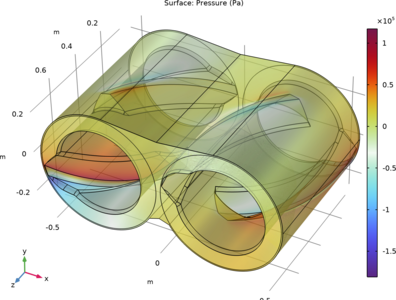
Non-isothermal non-Newtonian flow in an internal mixer for rubbers and polymers. The Carreau model is used including thermal effects for the viscosity. En savoir plus
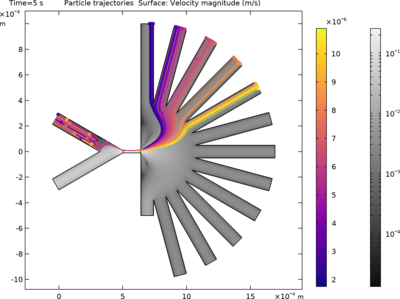
This example simulates the separation of particles based on the size in a microchannel using the method of pinched flow fractionation. The microdevice has two inlets and multiple outlets where the velocity field of liquid flow is calculated using the Laminar Flow interface. Then the ... En savoir plus
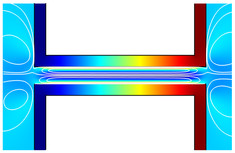
This model is a benchmark model for the Slip Flow interface. It is based on both analytic and numeric calculations. Air at atmospheric pressure flows through a conducting micro-channel connecting two reservoirs maintained at different temperatures. A flow between the two reservoirs ... En savoir plus
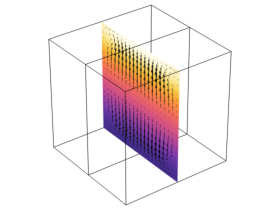
This example studies the stationary state of free convection in a cavity filled with water and bounded by two vertical plates. To generate the buoyancy flow, the plates are heated at different temperatures, bringing the regime close to the transition between laminar and turbulent. To ... En savoir plus
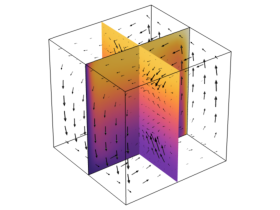
This example studies the stationary state of free convection in a cavity filled with air and bounded by two vertical plates. To generate the buoyancy flow, the plates are heated at different temperatures, set in a range to keep the flow laminar. En savoir plus
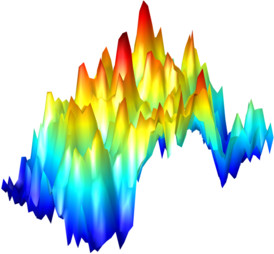
A potential flow model of fluid flow in a rock fracture uses the so-called Reynolds equation. It shows how to use experimental data interpolated to a function used in the equation. En savoir plus
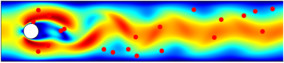
The following model examines unsteady, incompressible flow past a long cylinder placed in a channel at right angle to the oncoming fluid. The cylinder is offset somewhat from the center of the flow to make the steady-state symmetrical flow unstable. The simulation time necessary for a ... En savoir plus