
La Bibliothèque d'Applications présente des modèles construits avec COMSOL Multiphysics pour la simulation d'une grande variété d'applications, dans les domaines de l'électromagnétisme, de la mécanique des solides, de la mécanique des fluides et de la chimie. Vous pouvez télécharger ces modèles résolus avec leur documentation détaillée, comprenant les instructions de construction pas-à-pas, et vous en servir comme point de départ de votre travail de simulation. Utilisez l'outil de recherche rapide pour trouver les modèles et applications correspondant à votre domaine d'intérêt. Notez que de nombreux exemples présentés ici sont également accessibles via la Bibliothèques d'Applications intégrée au logiciel COMSOL Multiphysics® et disponible à partir du menu Fichier.
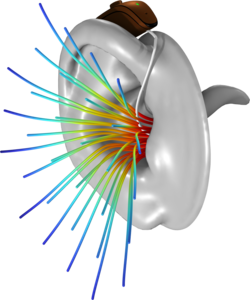
This model demonstrates how to perform a hearing aid acoustic feedback response analysis, including both the in-ear hearing aid and the hearing aid cassette. The hearing aid modeled is a ReSound OMNIA™ device from GN Hearing A/S. The hearing aid is tested on a combined pinna and ear ... En savoir plus
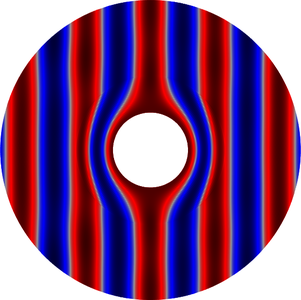
This example demonstrates how to use a background field in a sound scattering problem. The application is an acoustic invisibility cloak made of a metamaterial. Two different types of metamaterials are used, one using an anisotropic acoustic material with varying properties and one using ... En savoir plus
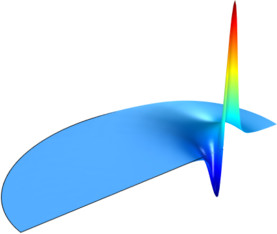
An ellipse with sound-hard walls has the interesting property that an acoustic signal emanating from one of the foci refocuses at the other focal point b/c seconds later, where b (in meters) is the major axis length and c (m/s) is the speed of sound. This model involves a Gaussian ... En savoir plus
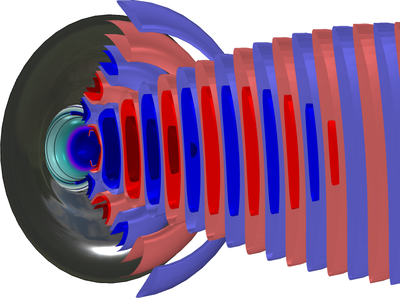
A tweeter is a high frequency driver used in loudspeaker systems. An ideal tweeter will produce a constant sound pressure level at a given distance in front of the driver independently of frequency, that is, a flat response. Ideally the tweeter will also, to a certain degree, maintain ... En savoir plus
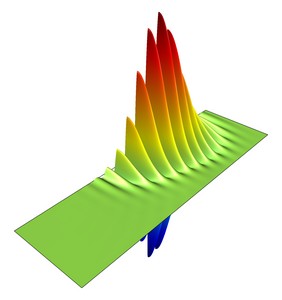
It is possible to generate harmonics that are multiples of the frequency of laser light by using nonlinear optical materials. This model demonstrates second harmonic generation using transient wave simulation and nonlinear material properties. A YAG (lambda=1.06 micron) laser beam is ... En savoir plus
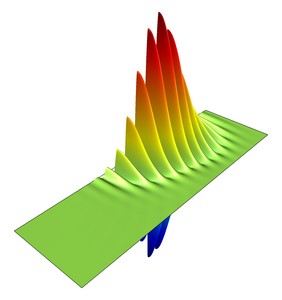
Laser systems are an important application area in modern electronics. With nonlinear materials it is possible to generate harmonics that are a multiple of the frequency of the laser light. This model shows how a second harmonic generation can be set up as a transient wave simulation, ... En savoir plus
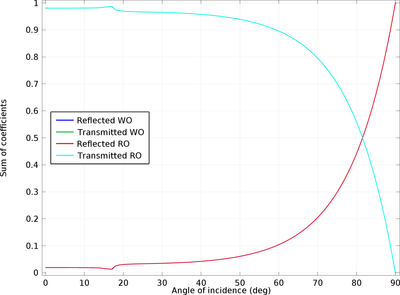
This model uses the Wave Optics Module and the Ray Optics module to model the propagation of rays through a diffraction grating at different angles of incidence. It uses the S-parameters computed by the Electromagnetic Waves, Frequency Domain interface on a unit cell of the grating to ... En savoir plus
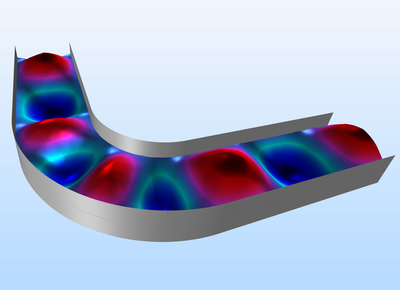
These examples show how to model a rectangular waveguide for microwaves in 2D and 3D. A single hollow waveguide can conduct two kinds of electromagnetic waves: transversal magnetic (TM) or transversal electric (TE) waves. The models examine a TE wave that has no electric field ... En savoir plus

The mutual inductance between a primary and secondary single turn coil in a concentric coplanar arrangement is computed using a DC, steady-state, model and compared against the analytic solution. The induced currents in the secondary coil are computed using an AC, frequency-domain, ... En savoir plus
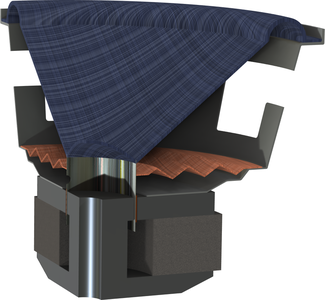
This tutorial shows how to best solve full 3D vibro-electroacoustic multiphysics models of loudspeakers. The model is based on a 3D representation of the existing 2D axisymmetric Application Library model loudspeaker_driver found in the software. The setup of the physics is essentially ... En savoir plus


