
La Bibliothèque d'Applications présente des modèles construits avec COMSOL Multiphysics pour la simulation d'une grande variété d'applications, dans les domaines de l'électromagnétisme, de la mécanique des solides, de la mécanique des fluides et de la chimie. Vous pouvez télécharger ces modèles résolus avec leur documentation détaillée, comprenant les instructions de construction pas-à-pas, et vous en servir comme point de départ de votre travail de simulation. Utilisez l'outil de recherche rapide pour trouver les modèles et applications correspondant à votre domaine d'intérêt. Notez que de nombreux exemples présentés ici sont également accessibles via la Bibliothèques d'Applications intégrée au logiciel COMSOL Multiphysics® et disponible à partir du menu Fichier.
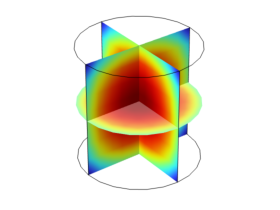
These models use the Discrete Ordinates method (DOM) and P1 approximation to solve a 3D radiative transfer problem in an emitting, absorbing, and linear-anisotropic scattering finite cylindrical medium. Using the S6 quadrature of DOM leads to accurate results, which are needed in ... En savoir plus
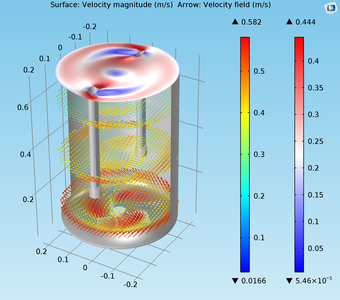
This example of turbulent flow in a partially baffled turbulent mixer shows how to set up The Rotating Machinery, Turbulent Flow interfaces from the Mixer Module with free surface and stationary free surface features. Both frozen rotor and time-dependent simulations are performed and ... En savoir plus
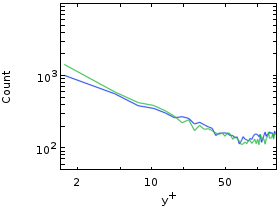
In this benchmark model, solid particles are released in a fully developed turbulent channel flow. The particles are subjected to a drag force that includes contributions from the fluid turbulence, implemented using a Continuous Random Walk (CRW) model. Because the turbulence in the ... En savoir plus
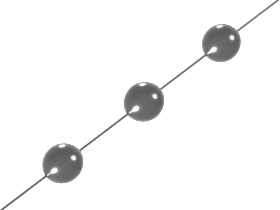
This example applies an Oldroyd-B fluid to model the thinning of a viscoelastic filament under the action of surface tension. For times smaller than the polymer relaxation time, the filament develops a beads-on-string structure. At times much larger than the relaxation time, the solution ... En savoir plus
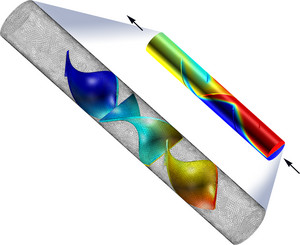
In static mixers, also called motionless or in-line mixers, a fluid is pumped through a pipe containing stationary blades. This mixing technique is particularly well suited for laminar flow mixing because it generates only small pressure losses in this flow regime. This example studies ... En savoir plus
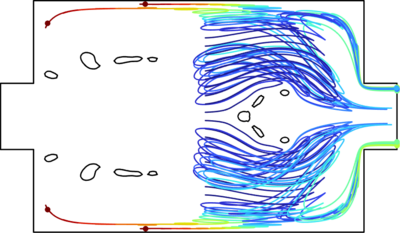
This example performs a topological optimization for a Tesla microvalve for an oscillating pressure drop. A Tesla microvalve inhibits backward flow using friction forces rather than moving parts, and therefore the objective is to maximize the average flow rate. The design can be ... En savoir plus
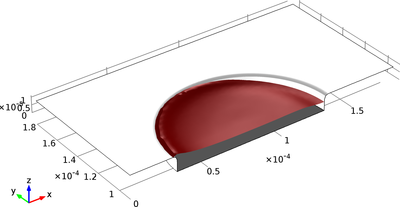
This model simulates the shape evolution of a microconnector bump over time as copper deposits on an electrode surface. Transport of cupric ions in the electrolyte occurs by convection and diffusion. The electrode kinetics are described by a concentration dependent Butler-Volmer ... En savoir plus
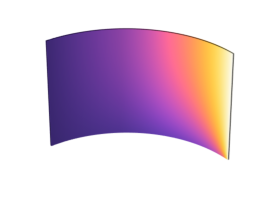
This model simulates a static analysis of heat conduction in a thin conductive shell. This is a benchmark model where the result is compared with a NAFEMS benchmark solution. En savoir plus
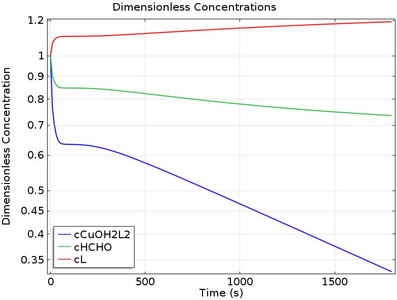
Electroless deposition or plating is a non-galvanic plating method that does not require any external electrical power. This technique is typically used for electroless plating of nickel, silver, gold and copper. In electroless deposition, partial oxidation and reduction reactions ... En savoir plus
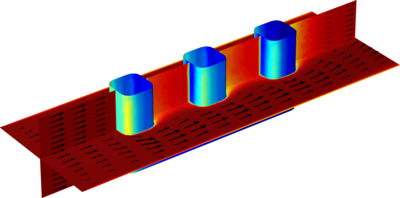
The electrochemical cell shown in this model can be regarded as a unit cell of a larger wire-mesh electrode that is common in many industrial processes. One of the most important aspects in the design of electrochemical cells is the current density distributions in the electrolyte and ... En savoir plus


