
La Bibliothèque d'Applications présente des modèles construits avec COMSOL Multiphysics pour la simulation d'une grande variété d'applications, dans les domaines de l'électromagnétisme, de la mécanique des solides, de la mécanique des fluides et de la chimie. Vous pouvez télécharger ces modèles résolus avec leur documentation détaillée, comprenant les instructions de construction pas-à-pas, et vous en servir comme point de départ de votre travail de simulation. Utilisez l'outil de recherche rapide pour trouver les modèles et applications correspondant à votre domaine d'intérêt. Notez que de nombreux exemples présentés ici sont également accessibles via la Bibliothèques d'Applications intégrée au logiciel COMSOL Multiphysics® et disponible à partir du menu Fichier.
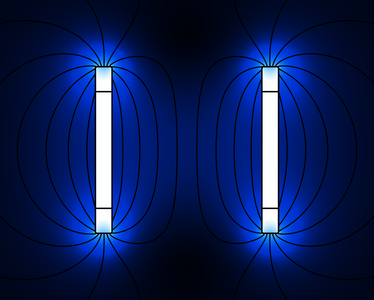
In this set of verification models and associated documentation, the accuracy of electromagnetic force calculations is investigated. Using various techniques, the total force and torque on a rigid body is determined and compared to analytical models. Using fillets, advanced meshing and ... En savoir plus
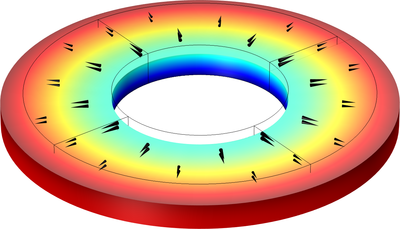
This tutorial model shows how a user-defined coordinate system can be used to create any type of directional polarization of a piezoelectric material. Results are shown for the case of radial polarization of a piezoelectric disk. The piezoelectric material is PZT-5H. The example shows a ... En savoir plus
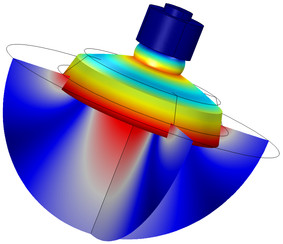
The tonpilz (sound mushroom) piezoelectric transducer is a transducer for relatively low frequency, high power sound emission. The transducer consists of piezoceramic rings stacked between massive ends and pre-stressed by a central bolt. The tail and head mass lower the resonance ... En savoir plus
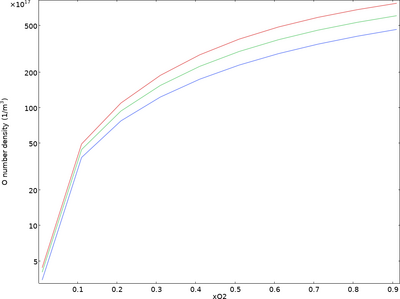
In this example, an CF4/O2 plasma reactor at low pressure is studied using a global model. Parametric sweeps for pressure and oxygen mole fraction are computed. En savoir plus
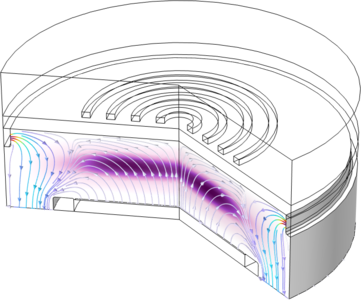
This tutorial studies the etching of silicon using an inductively coupled plasma reactor with an RF bias in a mixture of CF4/O2. The etching rate is computed along the wafer as a function of the RF bias voltage. En savoir plus
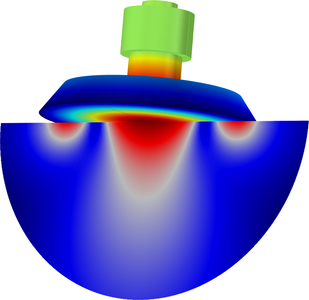
A tonpilz transducer is used for relatively low frequency, high power sound emission. It is one of the popular transducer configurations for SONAR applications. The transducer consists of piezoceramic rings stacked between a head mass and a tail mass which are connected by a central ... En savoir plus
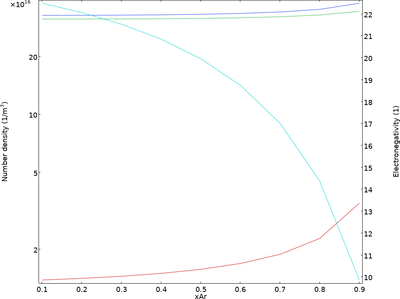
In this example, an SF6/argon plasma reactor at moderate pressure is studied using a global model. The heavy species heat equation is included. Parametric sweeps for input power and argon mole fraction are computed. En savoir plus
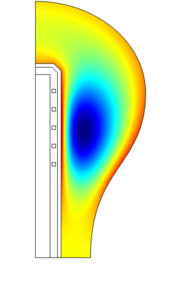
This model simulates an electrodeless lamp with argon/mercury chemistry. The low excitation threshold for mercury atoms means that even though the mercury is present in small concentrations, its behavior dominates. There is strong UV emission from the plasma at 185 nm and 253 nm. The UV ... En savoir plus
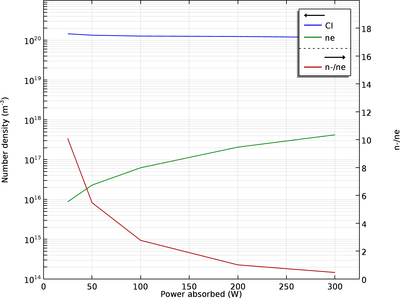
Plasma discharges containing chlorine are commonly used to etch semiconductors and metals in microelectronics fabrication. This tutorial model studies chlorine plasma discharges using a global (volume-averaged) diffusion model. Global diffusion models can run simulations in a fraction ... En savoir plus
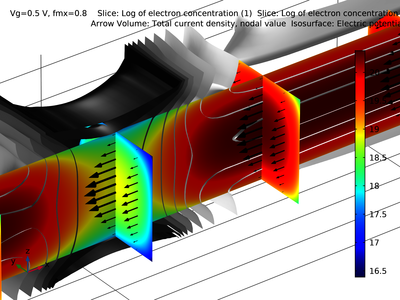
This 3D model of a nanowire MOSFET employs the density-gradient theory to add the effect of quantum confinement to the conventional drift-diffusion formulation, without requiring excessively high computational costs. The oxide layer is simulated explicitly with geometric domains, and ... En savoir plus


