
La Bibliothèque d'Applications présente des modèles construits avec COMSOL Multiphysics pour la simulation d'une grande variété d'applications, dans les domaines de l'électromagnétisme, de la mécanique des solides, de la mécanique des fluides et de la chimie. Vous pouvez télécharger ces modèles résolus avec leur documentation détaillée, comprenant les instructions de construction pas-à-pas, et vous en servir comme point de départ de votre travail de simulation. Utilisez l'outil de recherche rapide pour trouver les modèles et applications correspondant à votre domaine d'intérêt. Notez que de nombreux exemples présentés ici sont également accessibles via la Bibliothèques d'Applications intégrée au logiciel COMSOL Multiphysics® et disponible à partir du menu Fichier.
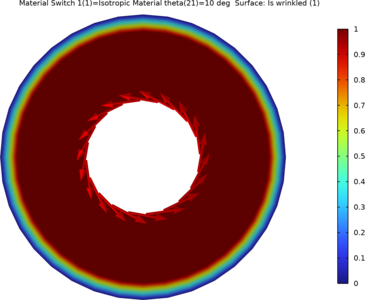
In this example, a torque is applied to the inner edge of a circular annulus-shaped membrane while the outer edge is fixed, resulting in membrane wrinkling. The wrinkling membrane model avoids the equilibrium instability that would be produced by the compressive stresses. The effect of ... En savoir plus
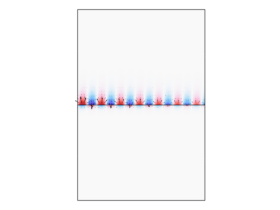
Electromagnetic waves that are confined to propagate along a surface, such as surface plasmon polaritons (SPPs), are of great research interest due to their potential applications in nanoscale manipulation of light. This model demonstrates how to set up a simulation of the propagation ... En savoir plus
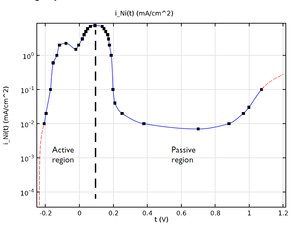
This model exemplifies the basic principles of crevice corrosion and how a time-dependent study can be used to simulate the electrode deformation. The model is in 2D and the polarization data for the corrosion reaction is taken from a paper by Absulsalam and others. The model and the ... En savoir plus
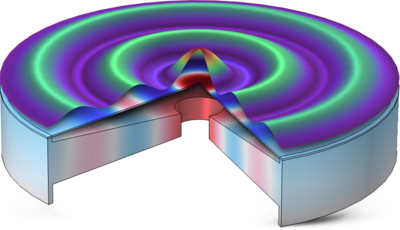
This example of a simple axisymmetric condenser microphone includes all the relevant physics and determines the microphone sensitivity as well as microphone capacitance for the specific simplified microphone geometry and material parameters. It solves a fully coupled multiphysics model ... En savoir plus
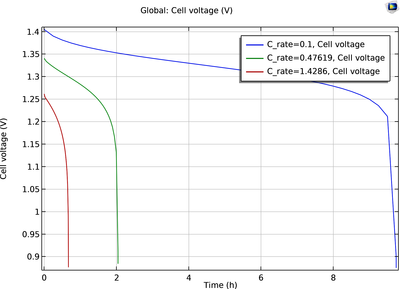
This model reproduces the NiCd battery model and the results presented in De Vidts' and White's paper from 1995. Ref: P. De Vidts, R. E. White, “Mathematical Modeling of a Nickel-Cadmium Cell: Proton Diffusion in the Nickel Electrode”, J. Electrochem. Soc, Vol. 142, No. 5, May 1995. En savoir plus
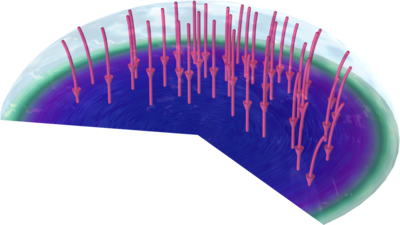
An Evans droplet experiment is a century-old corrosion experiment for demonstrating oxygen transport-limited corrosion. A droplet of water is placed on a metal surface, and over time the surface features differences in the radial direction of the surface in terms of amount of corroded ... En savoir plus
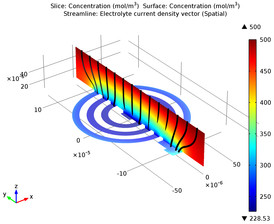
This example models the deposition of an inductor coil in 3D. The geometry includes the extrusion of the deposition pattern into an isolating photoresist mask, and a diffusion layer on top of the photoresist. The mass transfer of copper ions in the electrolyte has a major impact on the ... En savoir plus
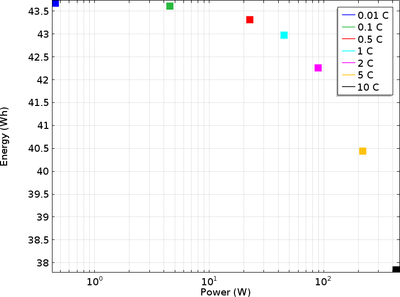
A battery’s possible energy and power outputs are crucial to consider when deciding in which type of device it can be used. A cell with high rate capability is able to generate a considerable amount of power, that is, it suffers from little polarization (voltage loss) even at high ... En savoir plus
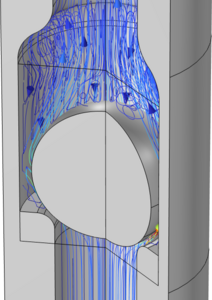
Using a Fluid-Solid Interaction multiphysics interface, the behavior of a spring-loaded ball check valve is studied under varying functional and reverse flow. The fluid force acting on the ball opens the valve at the opening pressure. In the case of a reversed pressure, the ball comes ... En savoir plus
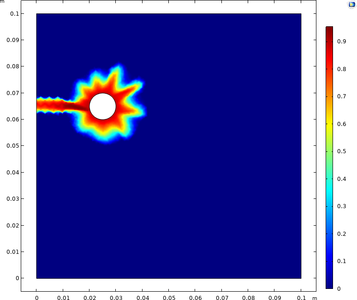
Oxide jacking is the process by which reinforced concrete cracks, due to the corrosion of the reinforcing rebar rods. The corrosion process causes growth of an oxide layer on the rebar, which in turn causes internal stresses in the concrete. If the corrosion process is allowed to ... En savoir plus


