
La Bibliothèque d'Applications présente des modèles construits avec COMSOL Multiphysics pour la simulation d'une grande variété d'applications, dans les domaines de l'électromagnétisme, de la mécanique des solides, de la mécanique des fluides et de la chimie. Vous pouvez télécharger ces modèles résolus avec leur documentation détaillée, comprenant les instructions de construction pas-à-pas, et vous en servir comme point de départ de votre travail de simulation. Utilisez l'outil de recherche rapide pour trouver les modèles et applications correspondant à votre domaine d'intérêt. Notez que de nombreux exemples présentés ici sont également accessibles via la Bibliothèques d'Applications intégrée au logiciel COMSOL Multiphysics® et disponible à partir du menu Fichier.

This tutorial simulates a standard test and benchmark model for perfectly matched layers (PMLs) as absorbing boundary conditions in the time domain. It involves the propagation of a transient Gaussian pulse with no flow. The Pressure Acoustics, Transient interface is used together with ... En savoir plus

This model example shows how to model nonlinear propagation of 1D finite-amplitude Acoustic waves in fluids using Acoustics Module of COMSOL Multiphysics. The model is based on the 2nd order Westervelt equation. The one dimensional nonlinear wave equation is solved in the time domain by ... En savoir plus
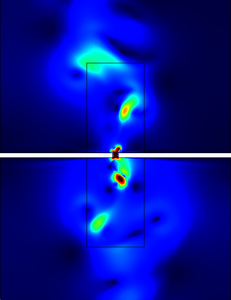
In many applications, acoustic waves interact with surfaces that have small perforations or slits. This can be in muffler systems; in soundproofing structures; in liners for noise suppression in jet engines; or in grilles and meshes in front of, for example, miniature speakers in mobile ... En savoir plus
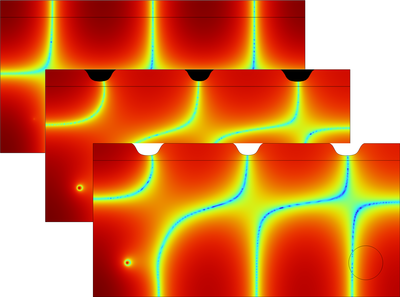
This tutorial introduces the use of topology optimization in acoustics. The goal of the optimization is to find the optimal material distribution (solid or air) in a given design domain, here the ceiling of a 2D room, that minimizes the average sound pressure level in an objective ... En savoir plus
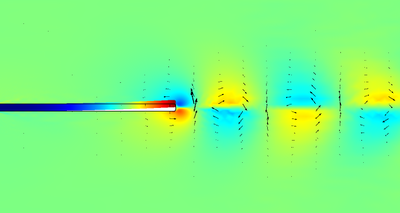
This is a small 2D demonstration model that couples the Linearized Navier-Stokes, Frequency Domain, Solid Mechanics, and Turbulent Flow (k-epsilon) physics interfaces to model the vibrations of a plate located in a 2D viscous parallel plate flow. This type of model is used to model fluid ... En savoir plus
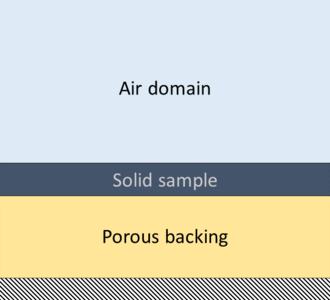
This app allows to calculate the absorption coefficient and surface impedance of a sound absorbers for normal and random incidences. The computed quantities can be used when setting up boundary conditions in a Pressure Acoustics, Frequency Domain model or a Ray Acoustics model. The ... En savoir plus

In this tutorial, the eigenmodes and eigenfrequencies of an air bubble in water is modeled and compared with analytical solutions. The effects of surface tension is included and allows to model both the pulsating mode and the surface modes of the bubble. Lastly, the effect of the ... En savoir plus
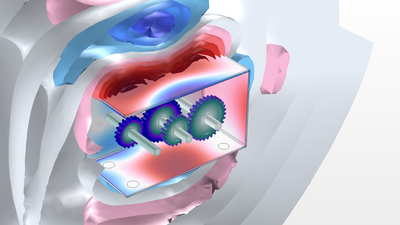
Predicting the noise radiation from a dynamic system gives designers insight into the behavior of moving mechanisms early in the design process. For example, consider a gearbox in which the change in the gear mesh stiffness causes vibrations. These vibrations are transmitted to the ... En savoir plus
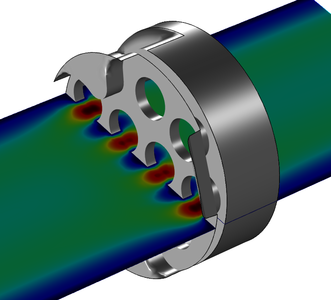
In this tutorial, the acoustic properties of a wax guard are analyzed. A wax guard is a small perforated mesh used to protect the receiver (the miniature loudspeaker in a hearing aid) used for receiver-in-the-ear (RITE) or receiver-in-canal (RIC) hearing aids. Because of the very small ... En savoir plus

The Bessel panel is a way to arrange a number of loudspeakers so that the angular sound distribution resembles that of a single speaker. This model combines five Bessel panels in the same pattern to approximate a purely radial sound field. The speakers are driven with different ... En savoir plus