
La Bibliothèque d'Applications présente des modèles construits avec COMSOL Multiphysics pour la simulation d'une grande variété d'applications, dans les domaines de l'électromagnétisme, de la mécanique des solides, de la mécanique des fluides et de la chimie. Vous pouvez télécharger ces modèles résolus avec leur documentation détaillée, comprenant les instructions de construction pas-à-pas, et vous en servir comme point de départ de votre travail de simulation. Utilisez l'outil de recherche rapide pour trouver les modèles et applications correspondant à votre domaine d'intérêt. Notez que de nombreux exemples présentés ici sont également accessibles via la Bibliothèques d'Applications intégrée au logiciel COMSOL Multiphysics® et disponible à partir du menu Fichier.
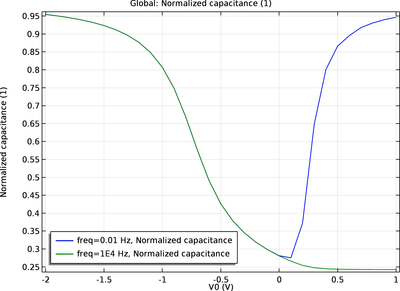
The metal-silicon-oxide (MOS) structure is the fundamental building block for many silicon planar devices. Its capacitance measurements provide a wealth of insight into the working principles of such devices. This tutorial constructs a simple 1D model of a MOS capacitor (MOSCAP). Both ... En savoir plus
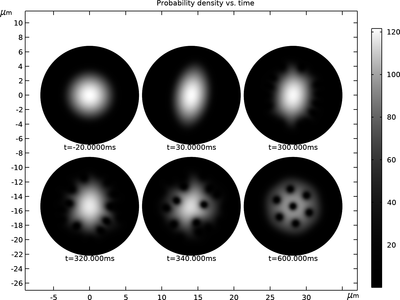
This tutorial model solves the Gross–Pitaevskii Equation for the vortex lattice formation in a rotating Bose–Einstein condensate bound by a harmonic trap. The equation is essentially a nonlinear single-particle Schrödinger Equation, with the inter-particle interaction represented by a ... En savoir plus
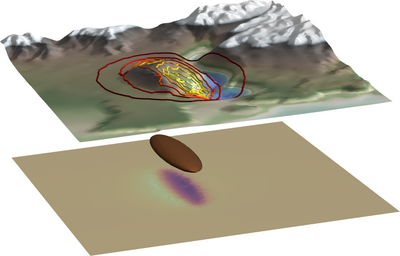
Magnetic prospecting is a geological exploration method that is applicable to certain types of iron ore deposits, in particular those made up of magnetite and hematite. The method consists of measuring the magnetic anomalies (changes in the earth's magnetic field) due to the presence of ... En savoir plus
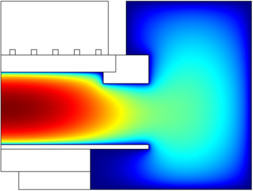
The GEC cell was introduced by NIST in order to provide a standardized platform for experimental and modeling studies of discharges in different laboratories. The plasma is sustained via inductive heating. The Reference Cell operates as an inductively-coupled plasma in this model. This ... En savoir plus
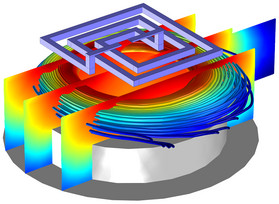
The COMSOL® software includes capabilities for 3D plasma modeling. In this example, a square coil is placed on top of a dielectric window and is electrically excited at 13.56 MHz. A plasma is formed in the chamber beneath the dielectric window, which contains argon gas at low ... En savoir plus
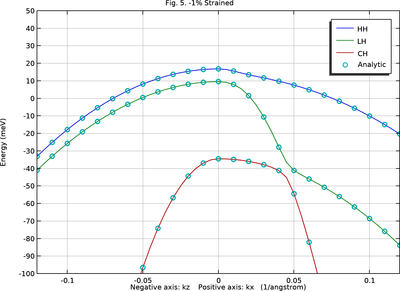
This benchmark model computes the valence band structure of an unstrained and a strained bulk GaN wurtzite crystal, as a tutorial for users who wish to set up multiple wave function components with the Schrödinger Equation interface. The model follows the formulation given in the ... En savoir plus
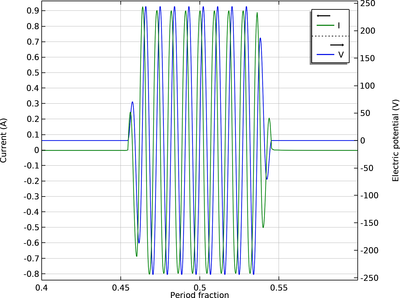
This tutorial model shows how to set up a model of a pulsed capacitive discharge. The on pulse consists of 10 periods of excitation at 13.56MHz, followed by no excitation for 100 periods. The I-V characteristics, the electron density, temperature and plasma potential are studied. En savoir plus
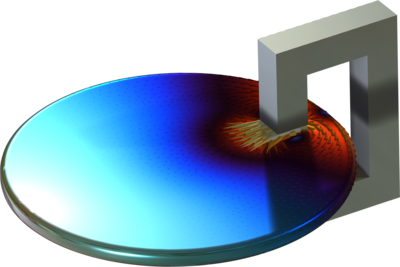
A magnetic brake consists of a permanent magnet, which induces currents in a rotating copper disk. The resulting eddy currents interact with the magnetic flux to produce Lorentz forces and subsequently a braking torque. This 3D problem is solved using a stationary formulation for the ... En savoir plus
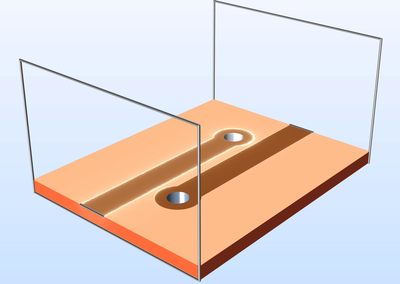
There are multiple ways to excite and terminate transmission lines using different types of port and lumped port features. In this example, transverse electromagnetic (TEM) type ports and a via type lumped port are used to simulate two adjacent microstrip lines. One via end is terminated ... En savoir plus
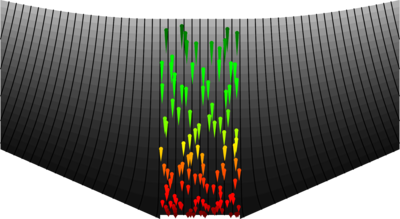
An electron gun must be able to draw a sufficient current and accelerate the electrons to the desired speed. The first part of an electron gun geometry presents unique design challenges because the emitted electron speeds are usually lowest there, and therefore the space charge density ... En savoir plus