
La Bibliothèque d'Applications présente des modèles construits avec COMSOL Multiphysics pour la simulation d'une grande variété d'applications, dans les domaines de l'électromagnétisme, de la mécanique des solides, de la mécanique des fluides et de la chimie. Vous pouvez télécharger ces modèles résolus avec leur documentation détaillée, comprenant les instructions de construction pas-à-pas, et vous en servir comme point de départ de votre travail de simulation. Utilisez l'outil de recherche rapide pour trouver les modèles et applications correspondant à votre domaine d'intérêt. Notez que de nombreux exemples présentés ici sont également accessibles via la Bibliothèques d'Applications intégrée au logiciel COMSOL Multiphysics® et disponible à partir du menu Fichier.
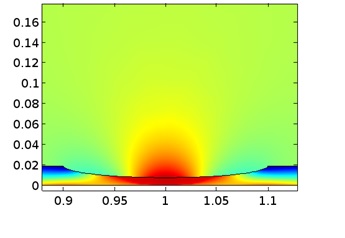
Steel pipelines are often subjected to complex stress/strain conditions in the oil and gas industry. Additionally, pipes are subjected to significant longitudinal strain due to soil movement. For the elastoplastic stress simulation, the Solid Mechanics interface is used with the small ... En savoir plus

This model illustrates how to perform prestressed eigenfrequency and frequency response analyses in a contact problem. A circular plate is squeezed between two thicker plates. The peak of the prestressed frequency response analysis is compared with the prestressed eigenfrequencies as ... En savoir plus
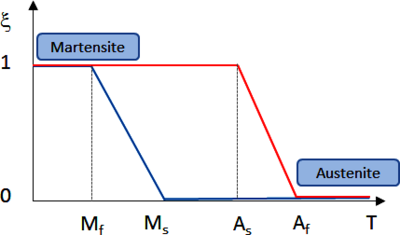
The model includes a compilation of benchmark examples included in the text book: Shape Memory Alloys: Modeling and Engineering Applications. D. Lagoudas Ed. Springer 2008. The model shows the thermomechanical properties of a NiTi alloy sample subjected to uniaxial tension-compression ... En savoir plus
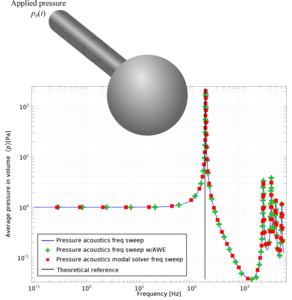
This model simulates a simple three-dimensional axisymmetric Helmholtz resonator, a classic acoustics model of a resonating circuit with a known theoretical solution. The idealized version considered here consists of a tube and a closed volume in series which are exposed to a pulsatile ... En savoir plus
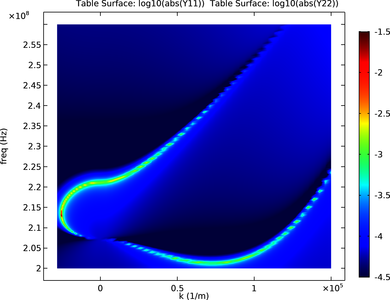
This model shows how to create dispersion diagrams from simulation results by extending the tutorial Thin-Film BAW Composite Resonator. The dispersion curve can be plotted against both real and imaginary values of the wave number, corresponding to the propagating modes and evanescent ... En savoir plus
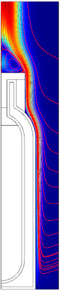
The following example solves a pure conduction and a free-convection problem in which a vacuum flask holding hot coffee dissipates thermal energy. The main interest is to calculate the flask's cooling power; that is, how much heat it loses per unit time. This tutorial model treats the ... En savoir plus
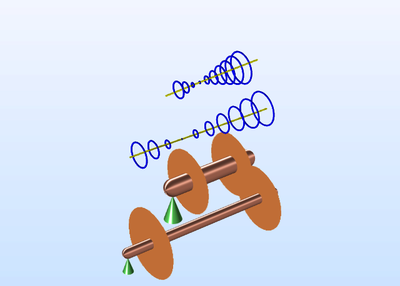
Due to the demand for larger power with a smaller size, dual-shaft systems with intershaft bearings are becoming a standard configuration for gas turbine engines. Such systems consist of two coaxial rotors running at different speeds, interlinked through a multi-spool bearing. In this ... En savoir plus
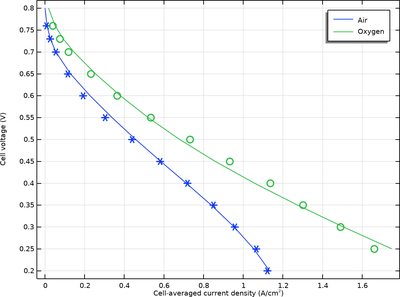
This tutorial demonstrates how to use stationary polarization data to perform parameter estimation of a polymer electrolyte membrane fuel cell (PEMFC) model. The model, defining a 5-layer membrane electrode assembly (MEA) is two-dimensional and includes electronic and ionic charge ... En savoir plus

This example simulates the thermodynamical evolution of moist air in an electronic box with the aim of detecting whether condensation occurs when the external environment properties change. The model imports measured data for the air temperature, pressure, and water vapor concentration. ... En savoir plus
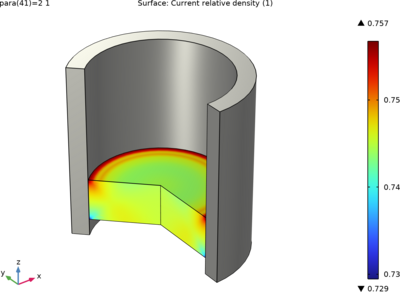
Powder compaction is a popular manufacturing process not only in powder metallurgy, but also in the pharmaceutical industry. The Capped Drucker–Prager model is commonly used for simulating the compaction processes of pharmaceutical powders, where the material properties depend on the ... En savoir plus


