
La Bibliothèque d'Applications présente des modèles construits avec COMSOL Multiphysics pour la simulation d'une grande variété d'applications, dans les domaines de l'électromagnétisme, de la mécanique des solides, de la mécanique des fluides et de la chimie. Vous pouvez télécharger ces modèles résolus avec leur documentation détaillée, comprenant les instructions de construction pas-à-pas, et vous en servir comme point de départ de votre travail de simulation. Utilisez l'outil de recherche rapide pour trouver les modèles et applications correspondant à votre domaine d'intérêt. Notez que de nombreux exemples présentés ici sont également accessibles via la Bibliothèques d'Applications intégrée au logiciel COMSOL Multiphysics® et disponible à partir du menu Fichier.
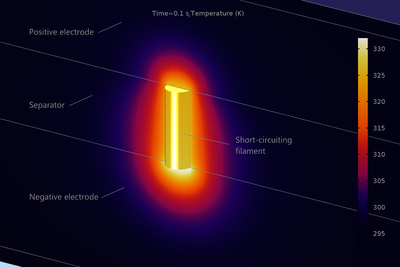
During an internal short circuit of a battery, the two electrode materials are internally and electronically interconnected, giving rise to high local current densities. Internal short circuits may occur in a lithium-ion battery due to, for instance, lithium dendrite formation or a ... En savoir plus
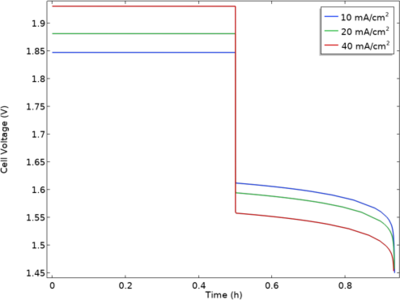
The zinc bromine redox flow battery is an electrochemical energy storage technology suitable for stationary applications. Compared to other flow battery chemistries, the Zn-Br cell potentially features lower cost, higher energy densities and better energy efficiencies. In the cell ... En savoir plus
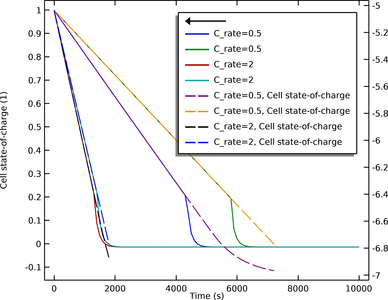
This tutorial demonstrates how to integrate multiple Lumped Battery models into the Electrical Circuit interface. Two batteries are connected in series. Each battery is protected by a shunt resistances that is activated if the battery state-of-charge reaches below a certain threshold ... En savoir plus
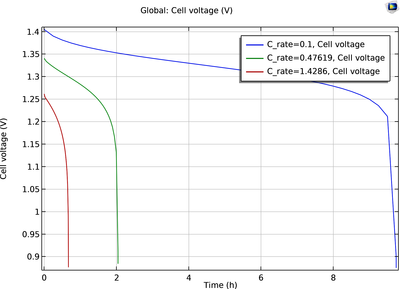
This model reproduces the NiCd battery model and the results presented in De Vidts' and White's paper from 1995. Ref: P. De Vidts, R. E. White, “Mathematical Modeling of a Nickel-Cadmium Cell: Proton Diffusion in the Nickel Electrode”, J. Electrochem. Soc, Vol. 142, No. 5, May 1995. En savoir plus
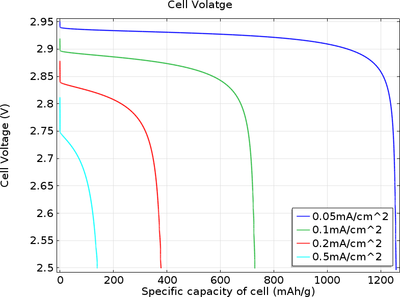
Rechargeable lithium-air batteries have recently attracted great interest mainly due to their high energy density. The theoretical value is about 11400 Wh/kg which is around 10 times greater than the lithium-ion batteries. In this tutorial, discharge of a lithium-air battery is ... En savoir plus
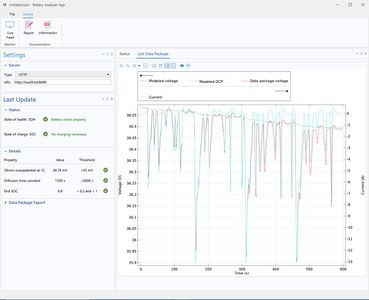
These two apps can be run to set up a digital twin of an electric scooter battery. The Digital Twin Simulator of an Electric Scooter Battery (the "simulator" app) simulates the use of an electric scooter and generates battery current and voltage data over time. The Digital Twin ... En savoir plus
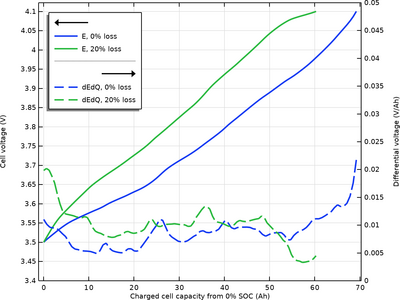
How the open-circuit voltage (OCV) of a lithium-ion battery varies with the state of charge is governed by various physical properties such as the thermodynamics of the electrode reactions, the relative capacities of the electrode materials, and the amount of cyclable lithium, but also ... En savoir plus
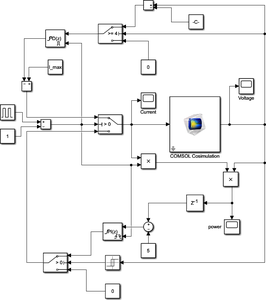
This model illustrates the charge/discharge control of a Lithium-Ion battery in a Simulink® simulation. En savoir plus
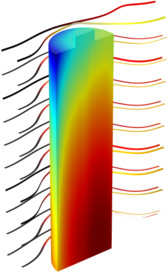
This example simulates the heat profile in an air-cooled cylindrical battery in 3d. The battery is placed in a matrix in a battery pack. The thermal model is coupled to a 1d-battery model that is used to generate a heat source in the active battery material. The model requires the ... En savoir plus
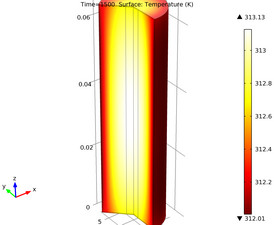
This model example simulates an air-cooled cylindrical 18650 lithium-ion battery during a charge-discharge cycle, followed by a relaxing period. A lumped (0D) cell model is used to model the battery cell chemistry, and a two-dimensional axi-symmetrical model is used to model the ... En savoir plus