
La Bibliothèque d'Applications présente des modèles construits avec COMSOL Multiphysics pour la simulation d'une grande variété d'applications, dans les domaines de l'électromagnétisme, de la mécanique des solides, de la mécanique des fluides et de la chimie. Vous pouvez télécharger ces modèles résolus avec leur documentation détaillée, comprenant les instructions de construction pas-à-pas, et vous en servir comme point de départ de votre travail de simulation. Utilisez l'outil de recherche rapide pour trouver les modèles et applications correspondant à votre domaine d'intérêt. Notez que de nombreux exemples présentés ici sont également accessibles via la Bibliothèques d'Applications intégrée au logiciel COMSOL Multiphysics® et disponible à partir du menu Fichier.

As an example of a magnetostatic problem, consider how to model a horseshoe-shaped permanent magnet. One way is to treat the entire magnet as a ferromagnetic material, where the two end sections are defined as being pre-magnetized in different and opposite directions. En savoir plus
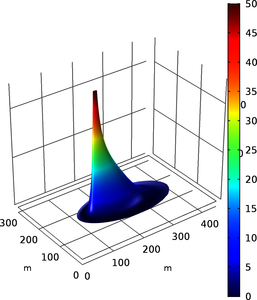
This model tracks a contaminant that enters an aquifer at a point, such as an injection well or toxic spill, and spreads through the aquifer with time. The model has an analytic solution developed by Wilson and Miller. This analytic solution has been used to test several dedicated fluid ... En savoir plus
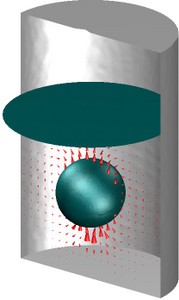
The level set method is well suited for problems with moving boundaries in which the geometry’s topology changes with time. A bubble of oil that travels up through water and finally merges with oil at the top causes this kind of topology change. For problems where the topology is ... En savoir plus
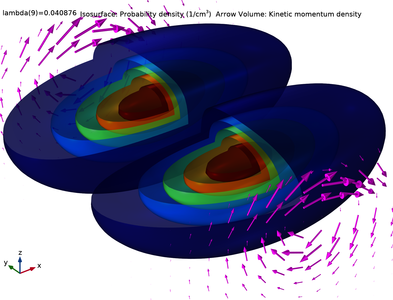
This tutorial model solves a two-component Schrödinger equation for the eigenstates of a simple silicon quantum dot in a uniform magnetic field, based on the paper by Jock et al. on the topic of spin-orbit qubits. The built-in domain condition Lorentz Force for the Schrödinger Equation ... En savoir plus

In this 2D tutorial, a test sample consists on one side of an isotropic material and on the other side of a heterogeneous anisotropic material (a transverse anisotropic zinc crystal). Elastic waves in the sample are excited by a point-like force. The model is solved with the Elastic ... En savoir plus
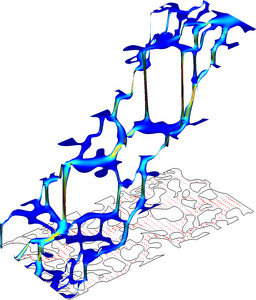
This non-conventional model of porous media flow utilizes creeping (Stokes) flow in the interstices of a porous media. The model comes from the pore-scale flow experiments conducted by Arturo Keller, Maria Auset, and Sanya Sirivithayapakorn of the University of California, Santa Barbara. ... En savoir plus
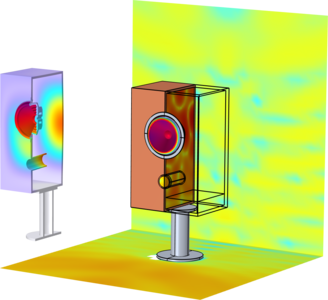
This model shows a full vibroacoustic analysis of a loudspeaker including driver, cabinet, and stand. It lets you apply a nominal driving voltage and extract the resulting sound pressure level in the cabinet and in the outside room, as well as the deformation of the cabinet and driver, ... En savoir plus
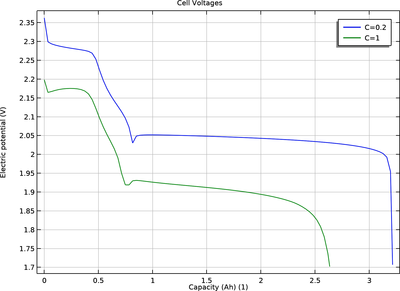
Lithium-sulfur (Li-S) batteries are used in niche applications with high demands for specific energy densities, which may be as high as 500-600 Wh/kg. The chemistry is fairly complex, since multiple polysulfide species participate in the various charge transfer reactions. The chemistry ... En savoir plus

This example simulates the thermodynamical evolution of moist air in an electronic box with the aim of detecting whether condensation occurs when the external environment properties change. The model imports measured data for the air temperature, pressure, and water vapor concentration. ... En savoir plus
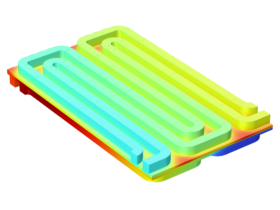
This tutorial explores the current distribution in a low-temperature PEMFC when using serpentine-based flow field patterns. The cell is operated in counter-flow mode so that the oxygen and hydrogen inlet flow streams are located at opposite sides. Relatively dry inlet gas compositions ... En savoir plus


