
La Bibliothèque d'Applications présente des modèles construits avec COMSOL Multiphysics pour la simulation d'une grande variété d'applications, dans les domaines de l'électromagnétisme, de la mécanique des solides, de la mécanique des fluides et de la chimie. Vous pouvez télécharger ces modèles résolus avec leur documentation détaillée, comprenant les instructions de construction pas-à-pas, et vous en servir comme point de départ de votre travail de simulation. Utilisez l'outil de recherche rapide pour trouver les modèles et applications correspondant à votre domaine d'intérêt. Notez que de nombreux exemples présentés ici sont également accessibles via la Bibliothèques d'Applications intégrée au logiciel COMSOL Multiphysics® et disponible à partir du menu Fichier.
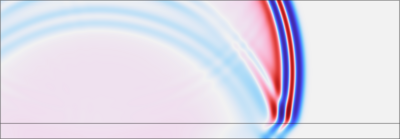
This tutorial studies the propagation of sound in the presence of a porous absorber in the time domain. It demonstrates how to model a porous absorber using the local and extended reacting approximations and compares the two approaches for absorbers of various thickness. The dissipative ... En savoir plus
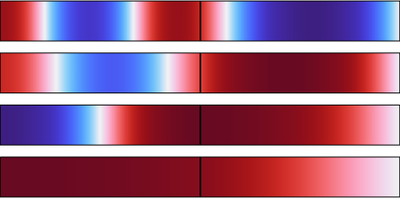
This tutorial demonstrates how to model the interaction between an acoustic field and the heat release from a flame, using the Flame Model domain feature. Modeling this interaction is important in order to understand and predict unstable acoustic modes in gas turbines and jet engines. ... En savoir plus
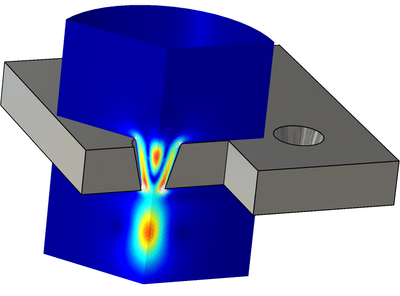
This model analyzes the nonlinear transfer impedance of a tapered orifice that can be part of a perforate or microperforated plate (MPP). The analysis is carried out for various degrees of tapering of the perforate and for a frequency range. A linear analysis is set up in the frequency ... En savoir plus
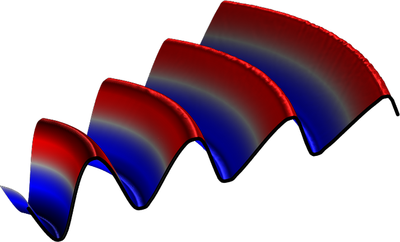
This model example shows how to model nonlinear propagation of a cylindrical wave using the Nonlinear Pressure Acoustics, Time Explicit physics interface available in Acoustics Module of COMSOL Multiphysics. The interface implements the system of nonlinear acoustic equations in the form ... En savoir plus
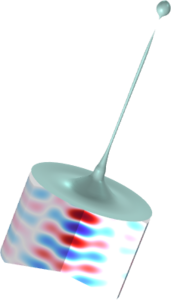
Acoustic droplet ejection is a non-contact, highly controllable method for liquid handling emerging in applications such as printing, biomedical, semiconductor assembly, and mass spectroscopy. The modeling approach assumes separation of acoustic and flow time scales. First, a focused ... En savoir plus

This model simulates the pressure wave propagation in a muffler for a combustion engine. It uses a general approach for analysis of damping of the propagation of harmonic pressure waves. The model is solved in the frequency domain and provides efficient damping in a frequency range of ... En savoir plus
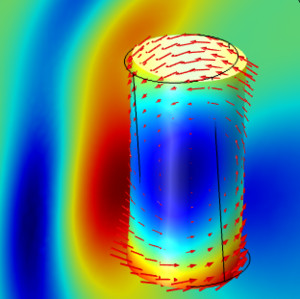
Liquid or gas acoustics coupled to structural objects such as membranes, plates or solids are important applications in many engineering fields. This model is a general demonstration of an acoustic fluid phenomenon in 3D that is coupled to a solid object. The walls of the solid object ... En savoir plus
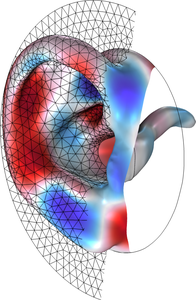
This model is of the P.57 Type 4.3 Full-band Ear Simulator. The model includes the geometry of the ear canal as well as the pinna defined in the ITU-T P.57 standard. The model also includes interpolation data for an ear drum impedance ensuring correct acoustic properties of the ear. The ... En savoir plus
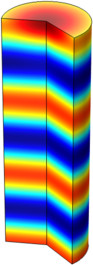
In this model, sound created by a vibrating piston radiates through a baffled pipe. The impedance is measured and then used in an impedance boundary condition that replaces the surrounding air domain. This technique can be employed to reduce solution time and memory usage for large ... En savoir plus

Finding acoustic eigenmodes in problems solved with linearized convected acoustic interfaces can be a challenging task. The solution will most often return several non-acoustic vorticity and entropy modes. These are highly damped waves that do not propagate at the speed of sound but with ... En savoir plus