
La Bibliothèque d'Applications présente des modèles construits avec COMSOL Multiphysics pour la simulation d'une grande variété d'applications, dans les domaines de l'électromagnétisme, de la mécanique des solides, de la mécanique des fluides et de la chimie. Vous pouvez télécharger ces modèles résolus avec leur documentation détaillée, comprenant les instructions de construction pas-à-pas, et vous en servir comme point de départ de votre travail de simulation. Utilisez l'outil de recherche rapide pour trouver les modèles et applications correspondant à votre domaine d'intérêt. Notez que de nombreux exemples présentés ici sont également accessibles via la Bibliothèques d'Applications intégrée au logiciel COMSOL Multiphysics® et disponible à partir du menu Fichier.
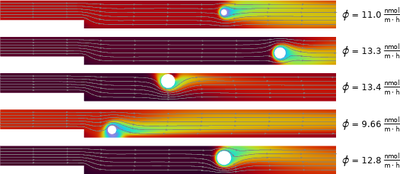
This tutorial illustrates how to use the Uncertainty Quantification (UQ) functionality to answer questions regarding sensitivity and reliability of a flow reactor with thermal decomposition. The tutorial investigates what uncertainties in parameters dominates the survival of a nutrient ... En savoir plus
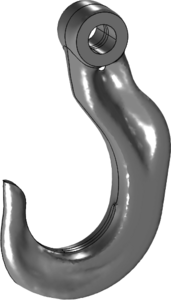
The model studies optimal material distribution in a hook, which is symmetric about the z plane and consists of a linear elastic material, structural steel. It is subjected to two distributed edge load cases: One at the tip of the hook and one along its lower inner curve. The geometry is ... En savoir plus
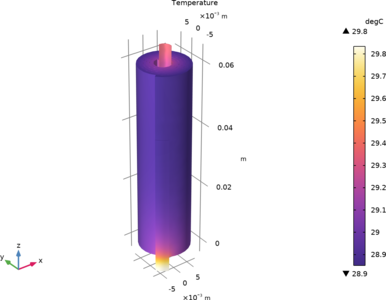
In a cylindrical or prismatic battery cell, the active layers, current collector metal foils and separators are wound into a “jelly roll”. Additional tabs (metal strips) are welded to the current collector foils in order to conduct the current to the exterior of the cell can. The ... En savoir plus

Removing halogen groups from hydrocarbons is an important reaction step in several chemical processes. One application is water purification. Other examples involve organic synthesis, where the removal of halogen groups serves as a starting point for carbon-carbon coupling reactions. ... En savoir plus
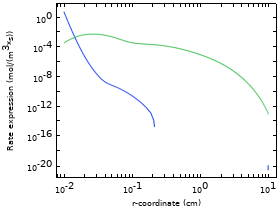
This tutorial presents a study of positive and negative corona discharges in dry air at atmospheric pressure. The discharges are sustained within two electrodes in a coaxial configuration by a high voltage DC source applied to the inner electrode. Two different types of models are used: ... En savoir plus
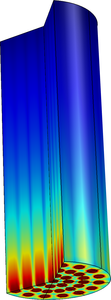
One of the most common reactors in the chemical industry, for use in heterogeneous catalytic processes, is the packed bed reactor. This type of reactor is used both in synthesis as well as in effluent treatment and catalytic combustion. This model is set up to calculate the ... En savoir plus
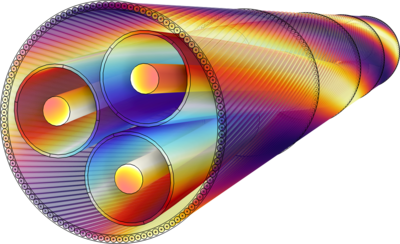
In this set of eight tutorial models and associated documentation, you can investigate the resistive, capacitive, inductive, and thermal properties of a standard three-core lead-sheathed XLPE HVAC submarine cable with twisted magnetic armor (500 mm2, 220 kV). The series includes a 2D, 2D ... En savoir plus

Many engineering structures consist of thin and slender components, where a full solid model will result in extremely many small elements. For such structures, it is much more efficient to use shell or beam elements. In this tutorial and verification model, it is shown how to connect ... En savoir plus
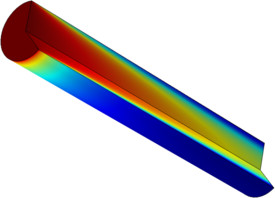
Chemical engineering students can model a nonideal tubular reactor, including radial and axial variations in temperature and composition, and investigate the impact of different operating conditions with this easy-to-use app. The process described by the Tubular Reactor with ... En savoir plus
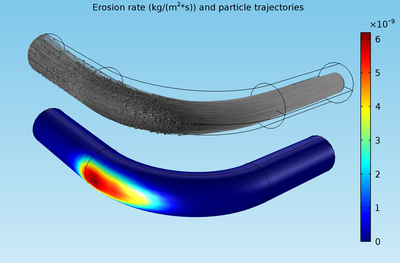
The Particle Tracing for Fluid Flow interface is used to compute the erosion of a pipe bend. The amount of material lost is computed using different erosion models. En savoir plus