
La Bibliothèque d'Applications présente des modèles construits avec COMSOL Multiphysics pour la simulation d'une grande variété d'applications, dans les domaines de l'électromagnétisme, de la mécanique des solides, de la mécanique des fluides et de la chimie. Vous pouvez télécharger ces modèles résolus avec leur documentation détaillée, comprenant les instructions de construction pas-à-pas, et vous en servir comme point de départ de votre travail de simulation. Utilisez l'outil de recherche rapide pour trouver les modèles et applications correspondant à votre domaine d'intérêt. Notez que de nombreux exemples présentés ici sont également accessibles via la Bibliothèques d'Applications intégrée au logiciel COMSOL Multiphysics® et disponible à partir du menu Fichier.
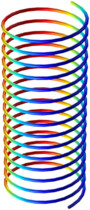
This model computes the trajectory of an ion in a uniform magnetic field using the Newtonian, Lagrangian and Hamiltonian formulations available in the Mathematical Particle Tracing interface. En savoir plus
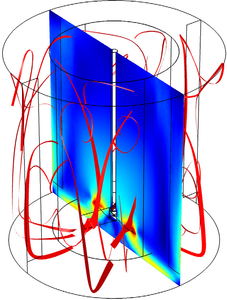
This tutorial example simulates the flow in a flat bottom mixer containing, agitated by a pitched four blade impeller, where the fluid is water, and flow is assumed to be turbulent. The flow in the mixer is modeled using the k-ε turbulence model, and a time-dependent simulation ... En savoir plus
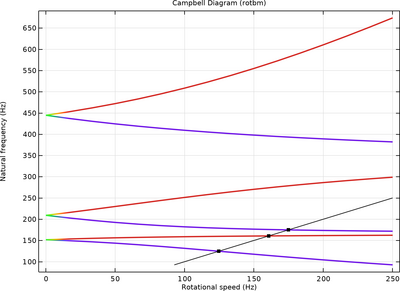
Different types of elements can be used for modeling a rotor, depending on the level of complexity and the type of the system being modeled. The modeling steps and representation of the results will vary with the type of idealization. In this tutorial model, an eigenfrequency analysis is ... En savoir plus

This example demonstrates how to model coupled flow, heat transfer, and structural deformation and stress in a pipeline network. Gravity loads from the pipe and fluid are also taken into account. En savoir plus

A tube connection consisting of a flange with eight prestressed bolts is subjected to a set of loads: an internal pressure, an axial force, and an external bending moment. Due to two symmetry planes, it is sufficient to only consider one quarter of the full geometry. The study ... En savoir plus
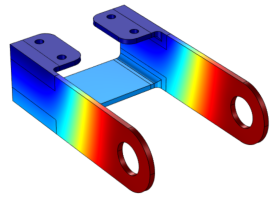
This tutorial example shows how to perform a random vibration analysis of a structure using power spectral density (PSD). The computations are based on the modal reduced order model (ROM). En savoir plus
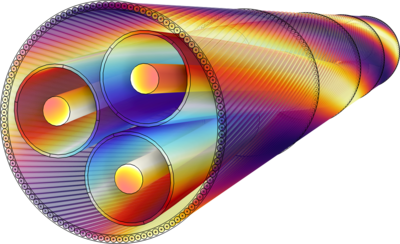
In this set of eight tutorial models and associated documentation, you can investigate the resistive, capacitive, inductive, and thermal properties of a standard three-core lead-sheathed XLPE HVAC submarine cable with twisted magnetic armor (500 mm2, 220 kV). The series includes a 2D, 2D ... En savoir plus
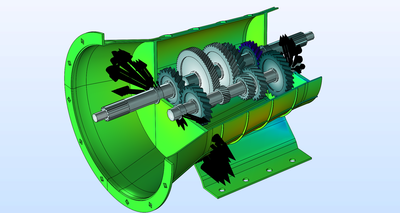
This example is an extension of a model used to study the vibration and noise in a 5-speed synchromesh gearbox in a manual transmission vehicle. In this version of the model, a detailed representation of a roller bearing is used instead of hinge joints with elastic stiffness. First, the ... En savoir plus
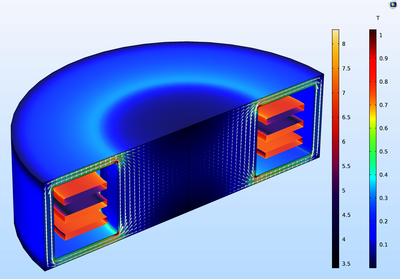
Inductive devices experience capacitative coupling between conductors at high frequencies. Modeling this phenomenon requires that you describe electric fields that have components both parallel with and perpendicular to the wire. This consideration might lead to the conclusion that a 3D ... En savoir plus
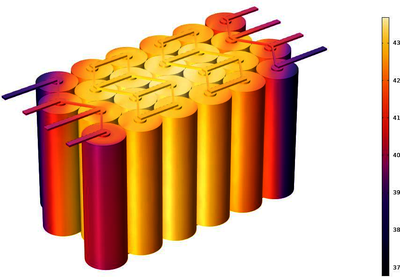
This app demonstrates the following: Dynamic help system using card stacks Multiple components (1D and 3D) in a single app Toggle buttons in the ribbon for showing different input, hiding/showing geometry selections, and for dynamic help Geometry parts and parameterized geometries ... En savoir plus