
La Bibliothèque d'Applications présente des modèles construits avec COMSOL Multiphysics pour la simulation d'une grande variété d'applications, dans les domaines de l'électromagnétisme, de la mécanique des solides, de la mécanique des fluides et de la chimie. Vous pouvez télécharger ces modèles résolus avec leur documentation détaillée, comprenant les instructions de construction pas-à-pas, et vous en servir comme point de départ de votre travail de simulation. Utilisez l'outil de recherche rapide pour trouver les modèles et applications correspondant à votre domaine d'intérêt. Notez que de nombreux exemples présentés ici sont également accessibles via la Bibliothèques d'Applications intégrée au logiciel COMSOL Multiphysics® et disponible à partir du menu Fichier.
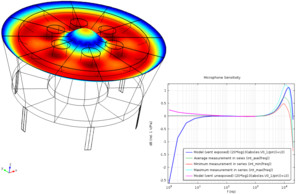
This is a model of the Brüel and Kjær 4134 (BK 4134) condenser microphone. The geometry and material parameters are those of the actual microphone. The modeled sensitivity level is compared to measurements performed on an actual microphone and shows good agreement. The membrane ... En savoir plus
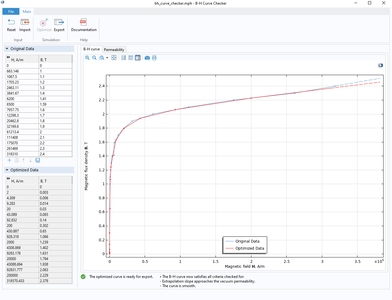
This app demonstrates the following: Importing measured data from a text file Handling measured data using methods Exporting the results to a text file. The app can be used to verify and optimize B–H curves using experimental data. It also generates curve data in the over-fluxed ... En savoir plus
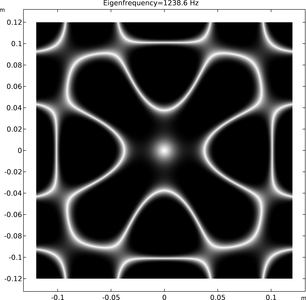
A Chladni plate is a metal plate that is covered in sand and subjected to vibrations. At certain frequencies, the vibrations produce standing waves, resulting in sand patterns formed on the plate. The vibrations are either formed from a violin bow at the side of the plate or a wave ... En savoir plus
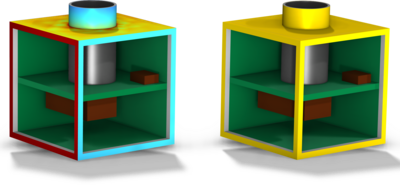
This model aims to demonstrate how a multilayer insulation can affect the temperature distribution of a satellite orbiting around the Earth. It is based on the Spacecraft Thermal Analysis model available in the Application Library. En savoir plus
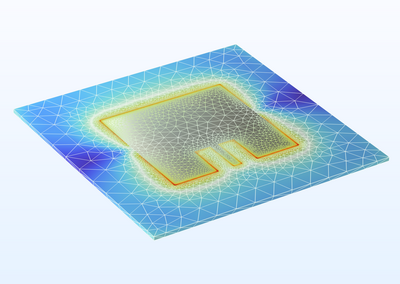
The model utilizes a dedicated mesh refinement study, Frequency Domain RF Adaptive Mesh, which dynamically refines the mesh in the region of interest. For the Application Library model Microstrip Patch Antenna, it increases the mesh resolution around areas with high field variations. The ... En savoir plus
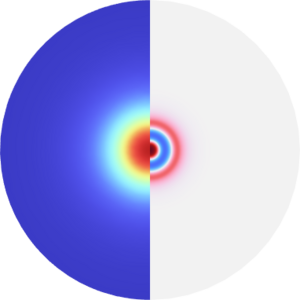
Stimulated Brillouin Scattering (SBS) describes a nonlinear interaction between light and sound. In optical fibers, SBS can be detrimental for power or communication purposes, but can be leveraged for sensing applications. The SBS gain spectrum quantifies the optic-acoustic mode ... En savoir plus

The eigenfrequencies of a rotating blade are studied in this benchmark. It shows how stress stiffening and the combined effect from stress stiffening and spin softening affects the fundamental eigenfrequency. High rotational speed in rotating machineries can result in centrifugal forces ... En savoir plus
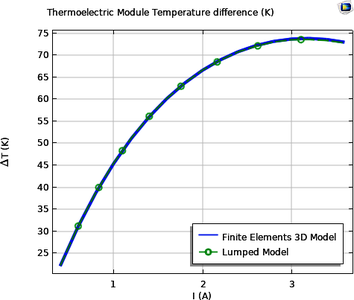
Thermoelectric coolers are widely used for electronics cooling in various application areas, ranging from consumer products to spacecraft design. The thermoelectric modules are a common application of thermoelectricity in cooling engineering. They consist of several thermoelectric legs ... En savoir plus
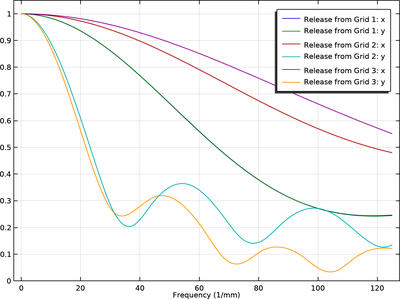
This model and tutorial demonstrates the use of an Application Method to compute and plot the geometric Modulation Transfer Function (MTF) for the Petzval Lens. En savoir plus
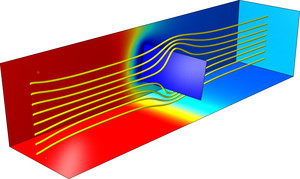
Chemical vapor deposition (CVD) allows a thin film to be grown on a substrate through molecules and molecular fragments adsorbing and reacting on a surface. This example illustrates the modeling of such a CVD reactor where triethyl-gallium first decomposes, and the reaction products ... En savoir plus


