
La Bibliothèque d'Applications présente des modèles construits avec COMSOL Multiphysics pour la simulation d'une grande variété d'applications, dans les domaines de l'électromagnétisme, de la mécanique des solides, de la mécanique des fluides et de la chimie. Vous pouvez télécharger ces modèles résolus avec leur documentation détaillée, comprenant les instructions de construction pas-à-pas, et vous en servir comme point de départ de votre travail de simulation. Utilisez l'outil de recherche rapide pour trouver les modèles et applications correspondant à votre domaine d'intérêt. Notez que de nombreux exemples présentés ici sont également accessibles via la Bibliothèques d'Applications intégrée au logiciel COMSOL Multiphysics® et disponible à partir du menu Fichier.
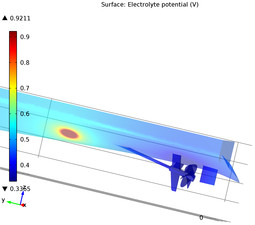
Impressed current cathodic protection is a commonly employed strategy to mitigate the ship hull corrosion where an external current is applied to the hull surface, polarizing it to a lower potential. In this model, the effect of propeller coating on the current demand is demonstrated. En savoir plus
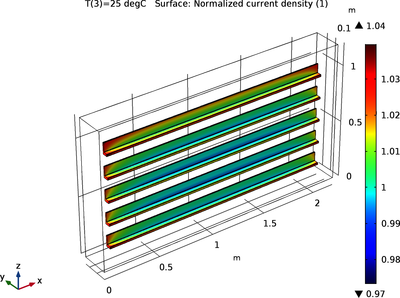
When anodizing aluminum, the surface is electrochemically altered to form an abrasive and corrosion-resistive Al2O3 film. The electrode kinetics during the process are only marginally affected as the oxide layer grows, so a stationary analysis of the current distribution is sufficient to ... En savoir plus
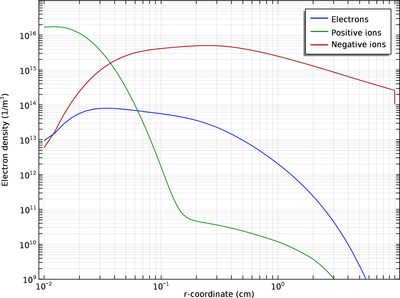
This tutorial model presents a study of a coaxial DC corona discharge in dry air at atmospheric pressure. The dimensions and operation conditions are similar to ones found in electrostatic precipitators with wire-to-plate configurations. The inner wire electrode has a 100-mm radius and ... En savoir plus
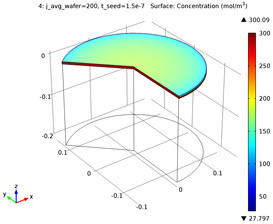
This example extends the analysis made in the model Electrodeposition on a Resistive Patterned Wafer by including the diffusion and convection of copper ions in the electrolyte. The coupled mass transport convection-diffusion effects are of interest in this type of reactor since they ... En savoir plus
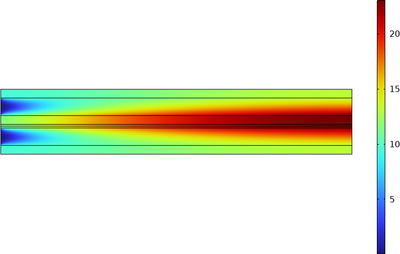
This example models co-electrolysis of H2O and CO2 using a solid oxide electrolyzer cell. The model includes the full coupling between the mass balances and gas flow in the H2 and O2 gas diffusion electrodes, the momentum balances in the H2 and O2 gas flow channels, the energy balance ... En savoir plus
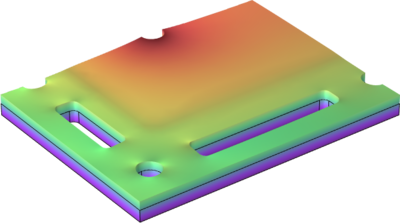
A fuel cell stack operates at temperatures just below 100 °C, which means that it has to be heated at start-up. The fuel cell stack consists of unit cell of anode, membrane, and cathode connected in series through bipolar plates. This study presents a model that couples the thermal and ... En savoir plus
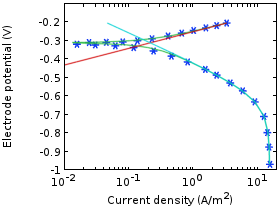
This tutorial shows how to use the Optimization interface to perform electrode kinetics parameter estimations based on polarization data. A zero-dimensional electrode polarization model is defined that separates kinetics expressions for the metal dissolution and the oxygen reduction ... En savoir plus
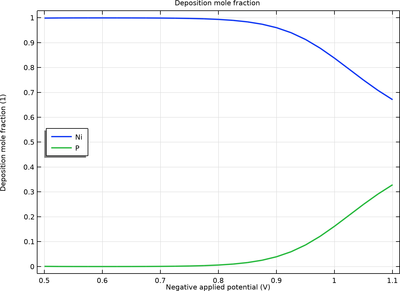
Electrochemical codeposition is a common low-cost method for producing metal alloys. This tutorial model demonstrates electrodeposition of a nickel (Ni)–phosphorous (P) alloy. The model accounts for charge and mass transport of a multitude of species along with multiple electrode ... En savoir plus
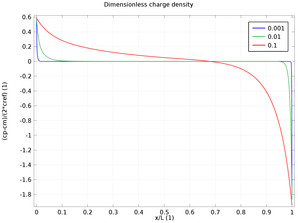
In the diffuse double layer and within the first few nanometers of an electrode surface, the assumption of electroneutrality is not valid due to charge separation. Typically, the diffuse double layer may be of interest when modeling very thin layers of electrolyte including those in ... En savoir plus
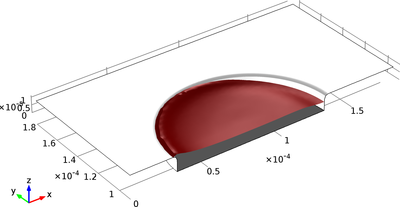
This model simulates the shape evolution of a microconnector bump over time as copper deposits on an electrode surface. Transport of cupric ions in the electrolyte occurs by convection and diffusion. The electrode kinetics are described by a concentration dependent Butler-Volmer ... En savoir plus


