
La Bibliothèque d'Applications présente des modèles construits avec COMSOL Multiphysics pour la simulation d'une grande variété d'applications, dans les domaines de l'électromagnétisme, de la mécanique des solides, de la mécanique des fluides et de la chimie. Vous pouvez télécharger ces modèles résolus avec leur documentation détaillée, comprenant les instructions de construction pas-à-pas, et vous en servir comme point de départ de votre travail de simulation. Utilisez l'outil de recherche rapide pour trouver les modèles et applications correspondant à votre domaine d'intérêt. Notez que de nombreux exemples présentés ici sont également accessibles via la Bibliothèques d'Applications intégrée au logiciel COMSOL Multiphysics® et disponible à partir du menu Fichier.

This tutorial model analyzes the propagation of seismic waves through Earth's internal structure. The model uses a 2D axisymmetric geometry to represent the material discontinuities and the variation of properties through the concentric layers of the earth. A simplified earthquake ... En savoir plus
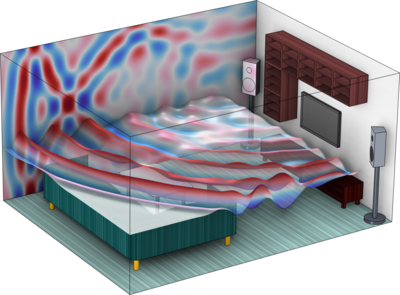
The use of wave-based techniques for room acoustic simulations has spread in the last years due to the increase in computational performance as well as the development of new numerical methods. The challenge of including realistic impedance conditions at walls is traditionally solved in ... En savoir plus
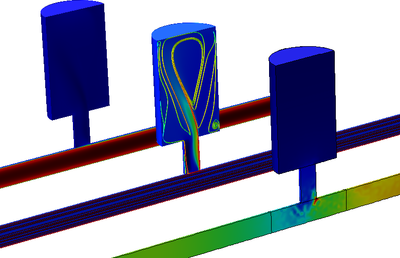
Helmholtz resonators are used in exhaust systems, as they can attenuate a specific narrow frequency band. The presence of a flow in the system alters the acoustic properties of the resonator and the transmission loss of the subsystem. In this tutorial model, a Helmholtz resonator is ... En savoir plus
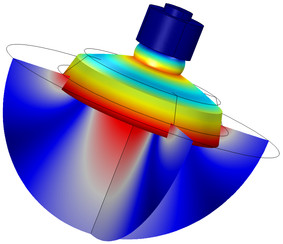
The tonpilz (sound mushroom) piezoelectric transducer is a transducer for relatively low frequency, high power sound emission. The transducer consists of piezoceramic rings stacked between massive ends and pre-stressed by a central bolt. The tail and head mass lower the resonance ... En savoir plus
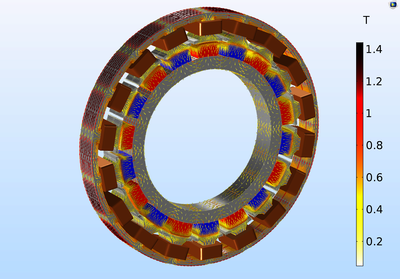
Permanent magnet (PM) motors are used in many high-end applications, such as in electric and hybrid vehicles. An important design limitation is that the magnets are sensitive to high temperatures, which can occur through heat losses caused by currents, particularly eddy currents. In ... En savoir plus
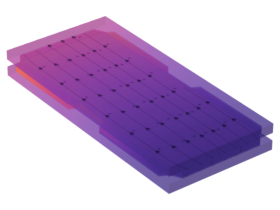
This tutorial models the thermal management of a polymer electrolyte membrane (PEM) fuel cell stack. Operating the stack with a similar temperature profile for all cells is important since an uneven temperature distribution may otherwise result in nonuniform water vapor condensation and ... En savoir plus
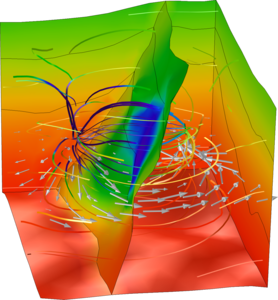
This is one of the two models from the blog post about heat transfer in the subsurface: Coupling Heat Transfer with Subsurface Porous Media Flow Note: Poroelasticity is not included here. En savoir plus
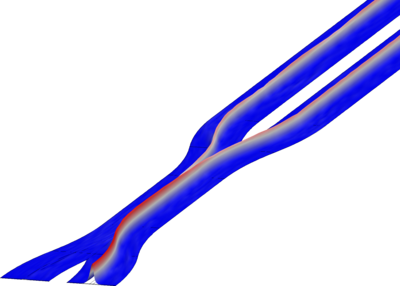
A Mach–Zehnder modulator is used for controlling the amplitude of an optical wave. The input waveguide is split into two waveguide interferometer arms. If a voltage is applied across one of the arms, a phase shift is induced for the wave passing through that arm. When the two arms are ... En savoir plus


