
La Bibliothèque d'Applications présente des modèles construits avec COMSOL Multiphysics pour la simulation d'une grande variété d'applications, dans les domaines de l'électromagnétisme, de la mécanique des solides, de la mécanique des fluides et de la chimie. Vous pouvez télécharger ces modèles résolus avec leur documentation détaillée, comprenant les instructions de construction pas-à-pas, et vous en servir comme point de départ de votre travail de simulation. Utilisez l'outil de recherche rapide pour trouver les modèles et applications correspondant à votre domaine d'intérêt. Notez que de nombreux exemples présentés ici sont également accessibles via la Bibliothèques d'Applications intégrée au logiciel COMSOL Multiphysics® et disponible à partir du menu Fichier.

In this tutorial model, the flow in a pipe with a bend is computed using the Pipe Flow interface. The computed fluid load is used as input to a stress analysis in the Pipe Mechanics interface. Gravity loads from the pipe and fluid are also taken into account. En savoir plus
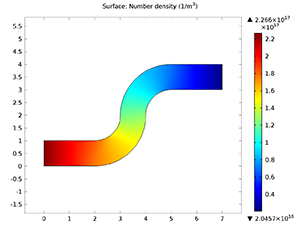
This model computes the transmission probability through an s-bend geometry using both the angular coefficient method available in the Free Molecular Flow interface and a Monte Carlo method using the Mathematical Particle Tracing interface. The computed transmission probability by the ... En savoir plus
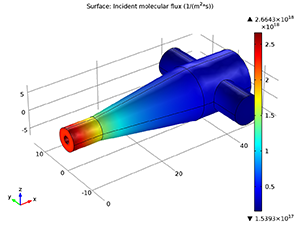
This model computes the transmission probability through an RF coupler using both the angular coefficient method available in the Free Molecular Flow interface and a Monte Carlo method using the Mathematical Particle Tracing interface. The computed transmission probability determined by ... En savoir plus
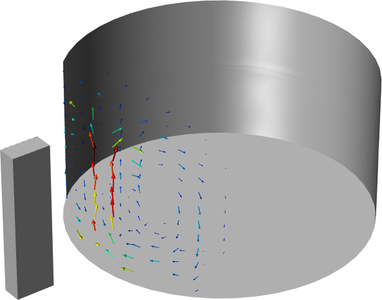
This is a tutorial how to set up electric machinery in 3D using a combination of the magnetic fields and magnetic fields no currents interfaces. En savoir plus
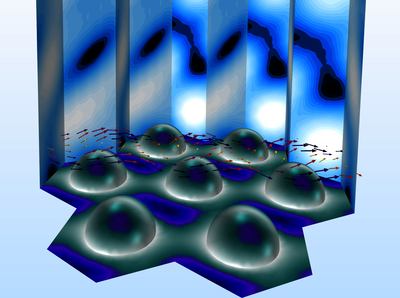
A plane wave is incident on a reflecting hexagonal grating. The grating cell consists of a protruding semisphere. The scattering coefficients for the different diffraction orders are calculated for a few different wavelengths. En savoir plus
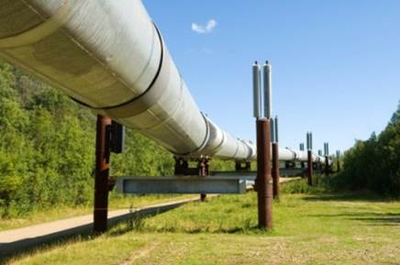
As oil flows through a pipeline section heat is released due to the work of internal friction forces in the fluid. With good insulation of the pipeline, this generated heat can be used to avoid preheating of the oil, despite the fact that it is to be transported in a cold environment ... En savoir plus

This model demonstrates how to design a beam without low Eigenfrequencies by combining the Density Model feature in the Topology Optimization interface with the Stationary Then Eigenfrequency study step. En savoir plus
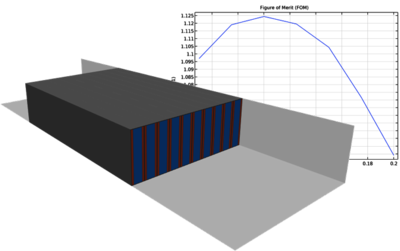
This example computes the effectiveness of a porous microchannel heat sink over a conventional microchannel heat sink. The model is fully parameterized. A parameter study on the thickness of the porous substrate is used to determine the optimal configuration. En savoir plus
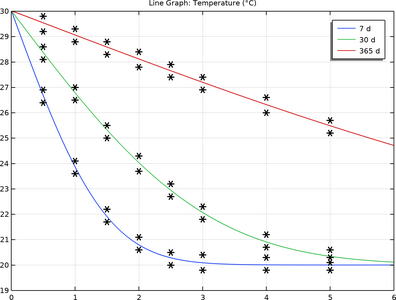
The model is defined as a benchmark case in norm 15026:2007 annex A. The purpose of the model is to calculate the temperature and moisture profiles at different times after a change in the external conditions (temperature and relative humidity) inside a wall material (kind of concrete). ... En savoir plus

This example models heat generation in a beam-like structure subjected to small amplitude vibrations. The model computes the linear elastic response in the frequency domain. The transient heat-transfer analysis simulates the slow-rising temperature in the beam using the heat generated ... En savoir plus


