
La Bibliothèque d'Applications présente des modèles construits avec COMSOL Multiphysics pour la simulation d'une grande variété d'applications, dans les domaines de l'électromagnétisme, de la mécanique des solides, de la mécanique des fluides et de la chimie. Vous pouvez télécharger ces modèles résolus avec leur documentation détaillée, comprenant les instructions de construction pas-à-pas, et vous en servir comme point de départ de votre travail de simulation. Utilisez l'outil de recherche rapide pour trouver les modèles et applications correspondant à votre domaine d'intérêt. Notez que de nombreux exemples présentés ici sont également accessibles via la Bibliothèques d'Applications intégrée au logiciel COMSOL Multiphysics® et disponible à partir du menu Fichier.

The present model example is based on Copper Deposition in a Trench model available in Electrodeposition Application Library. The nonuniform deposition along the trench surface leads to formation of a cavity/void. Since the Deformed Geometry interface cannot handle topological changes, ... En savoir plus
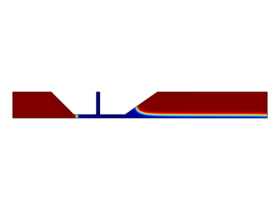
This tutorial shows how to model a slot die coating process with a power-law non-Newtonian fluid in one of the two phases. The model uses a two-phase flow phase-field method. En savoir plus
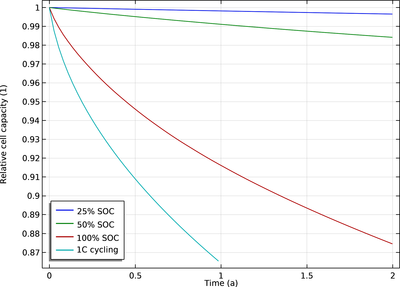
This tutorial demonstrates the Lumped Battery interface for modeling capacity loss in a battery. A set of lumped parameters are used to describe the capacity loss that occurs due to parasitic reactions in the battery, assuming no knowledge of the internal structure or design of the ... En savoir plus
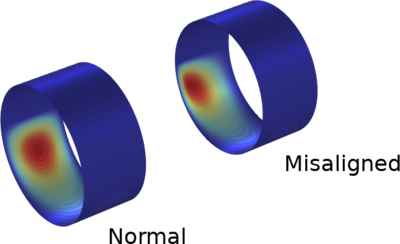
In this example, a rotor supported by two hydrodynamic bearings is analyzed. An eccentric disk located between the bearings induces rotor whirl. One of the bearings is misaligned with the rotor axis. The Beam Rotor interface with Hydrodynamic Bearing interface in the Rotordynamics ... En savoir plus
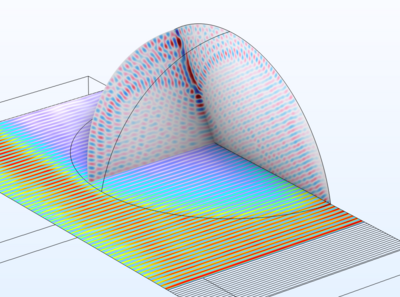
When a droplet is placed on a substrate on which surface acoustic waves (SAWs) are traveling, the energy of the SAWs is transferred into the droplet to form an acoustic field. The transferred energy is attenuated and generates a streaming flow. This type of streaming enables contactless ... En savoir plus
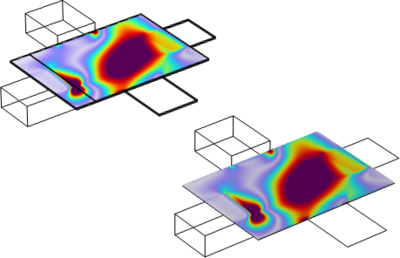
Layered shell elements, which are used for modeling composite shells, often connected to solid and shell elements in a cladding or side-by-side configuration to represent a realistic structure. For such applications, it becomes important to connect layered shell element correctly and ... En savoir plus
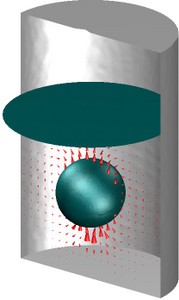
The level set method is well suited for problems with moving boundaries in which the geometry’s topology changes with time. A bubble of oil that travels up through water and finally merges with oil at the top causes this kind of topology change. For problems where the topology is ... En savoir plus
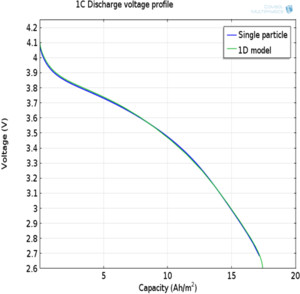
An isothermal single particle model formulation for a lithium-ion battery is presented in this work. The single particle model is a simplification of the 1D formulation for a lithium-ion battery along with a few assumptions. The model is typically valid for low-medium current scenarios. ... En savoir plus


