
La Bibliothèque d'Applications présente des modèles construits avec COMSOL Multiphysics pour la simulation d'une grande variété d'applications, dans les domaines de l'électromagnétisme, de la mécanique des solides, de la mécanique des fluides et de la chimie. Vous pouvez télécharger ces modèles résolus avec leur documentation détaillée, comprenant les instructions de construction pas-à-pas, et vous en servir comme point de départ de votre travail de simulation. Utilisez l'outil de recherche rapide pour trouver les modèles et applications correspondant à votre domaine d'intérêt. Notez que de nombreux exemples présentés ici sont également accessibles via la Bibliothèques d'Applications intégrée au logiciel COMSOL Multiphysics® et disponible à partir du menu Fichier.
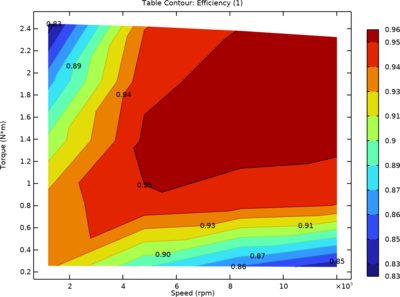
When electrical energy is converted into mechanical work in an electrical motor, the "wasted" energy that causes device heating is usually referred to as loss. The ratio of useful work to input energy, or the efficiency of the motor, is an important property for the overall energy ... En savoir plus
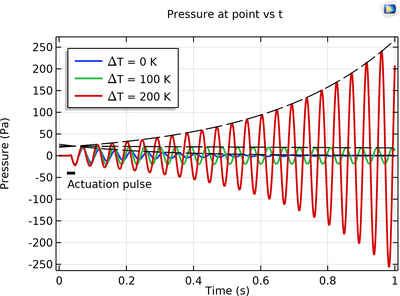
This is a model of a simple thermoacoustic engine that includes a thermal stack to convert thermal energy to acoustic energy. The model is set up using two approaches: 1) Using a linear perturbation (acoustic) approaches solving the fluid motion with the Thermoviscous Acoustics, ... En savoir plus
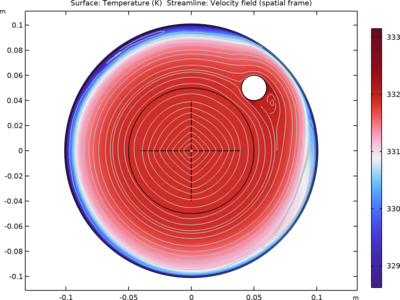
This model illustrates the modeling of temperature distribution in a simplified mixer. En savoir plus
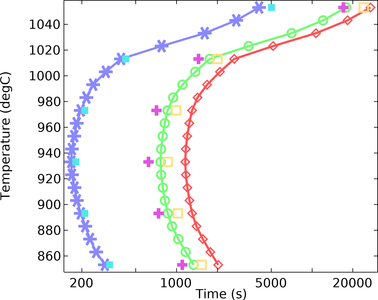
This model shows how to use the Metal Processing Module and the Optimization Module to calibrate parameters of a phase transformation model against TTT (Time Temperature Transformation) data. En savoir plus
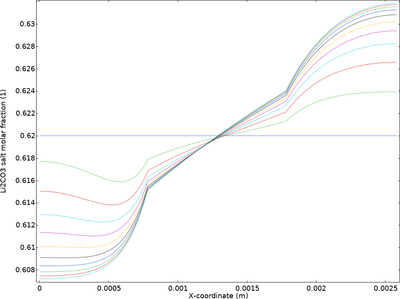
This tutorial shows how to model transport of the individual ions in a salt melt comprising two binary salts, where the transport equations are defined using concentrated solution theory. The example model defines a molten carbonate fuel cell (or electrolyzer), with a 1D-model geometry ... En savoir plus

The models simulate the working mechanism of traveling wave thermoacoustic engines. Similary to the standing wave engines, the traveling wave engines make use of the coupling between the fluid motion and the temperature change experienced by the fluid to generate acoustic energy. ... En savoir plus
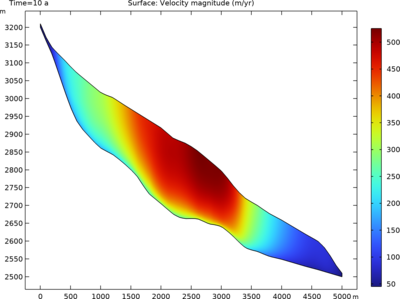
This example shows how to set up a glacier flow model in principle, containing several important aspects of glacier modeling: The creation of the 2D geometry, the modeling of non-Newtonian flow, and the implementation of basal sliding. In this example, two different glacier types, a cold ... En savoir plus
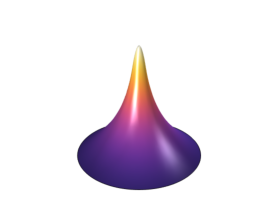
This classical verification model solves the steady state temperature distribution in a plan disk heated by a localized heat source at its center. It shows and compare different ways to define a heat source localized on a small domain by representing it either as a geometrical point or a ... En savoir plus
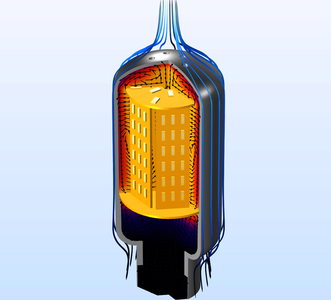
This model describes the three heat transfer modes: conduction, convection, and radiation, combined with nonisothermal flow in a realistic geometry representing a light bulb and the surrounding air. The LED chips dissipate heat. The model computes the equilibrium temperature induced by ... En savoir plus
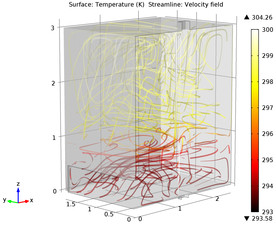
In general, there are two classes of ventilation: mixing ventilation and displacement ventilation. In displacement ventilation, air enters a room at the floor level and displaces warmer air to achieve the desired temperature. Heating sources in the room can include running electronic ... En savoir plus