
La Bibliothèque d'Applications présente des modèles construits avec COMSOL Multiphysics pour la simulation d'une grande variété d'applications, dans les domaines de l'électromagnétisme, de la mécanique des solides, de la mécanique des fluides et de la chimie. Vous pouvez télécharger ces modèles résolus avec leur documentation détaillée, comprenant les instructions de construction pas-à-pas, et vous en servir comme point de départ de votre travail de simulation. Utilisez l'outil de recherche rapide pour trouver les modèles et applications correspondant à votre domaine d'intérêt. Notez que de nombreux exemples présentés ici sont également accessibles via la Bibliothèques d'Applications intégrée au logiciel COMSOL Multiphysics® et disponible à partir du menu Fichier.

A benchmark model where a thick plate exposed to pressure on the top surface is analyzed. The solution is compared with a NAFEMS benchmark solution. En savoir plus
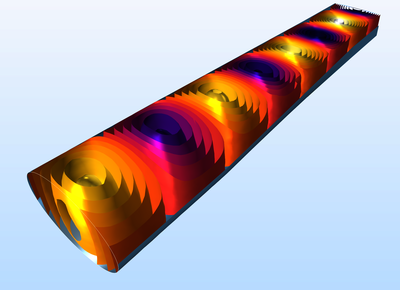
This is a model of an adapter for microwave propagation in the transition between a rectangular and an elliptical waveguide. Such waveguide adapters are designed to keep energy losses due to reflections at a minimum for the operating frequencies. To investigate the characteristics of the ... En savoir plus
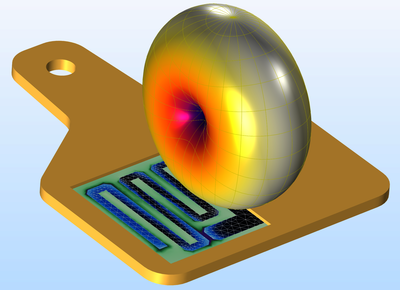
UHF RFID tags are widely used for identifying and tracking animals. This model simulates a passive radio-frequency identification (RFID) tag for the UHF frequency range. With respect to the chip transponder’s complex impedance, a reflection coefficient is computed. This is done using an ... En savoir plus
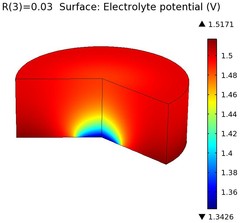
Magnesium alloys are attractive alternatives as lightweight materials in various fields of engineering. Magnesium is however relatively non-noble and may suffer considerable galvanic corrosion when being used in conjunction with other metals, for instance when mounting an Mg alloy ... En savoir plus
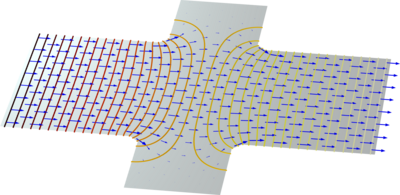
This example uses the Electric Currents in Layered Shells interface and the Layered Shell interface to model a piezoresistive pressure sensor. The tutorial considers the design of the MPX100 series pressure sensors originally manufactured by Motorola Inc. Although the sensor is no ... En savoir plus
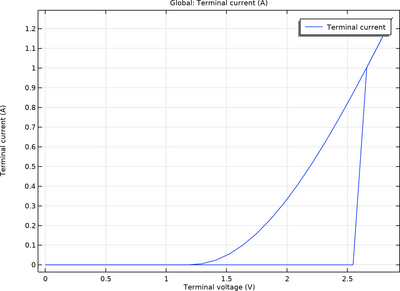
This model shows how to model a simple Shockley diode— a four-layer PNPN semiconductor device. The Shockley diode is also named as thyristor. In this model, the Analytic Doping Model node is utilized to define the doping profiles for each domain. A time-dependent study is employed to ... En savoir plus
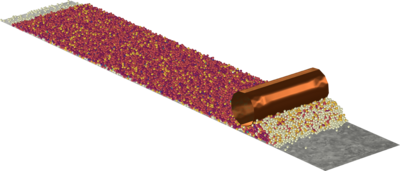
This example uses the Granular Flow interface to model the formation of the grain heap and then its subsequent spreading using a cylindrical roller. The roller has a combined rotational and translational motion. The resulting powder bed is then analyzed to determine its quality based on ... En savoir plus
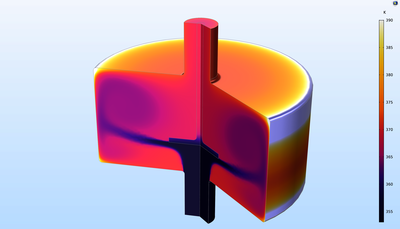
The engine block of a car includes a cooling jacket to remove excess heat from combustion. The cooling jacket consists of open spaces in the cylinder block and the cylinder head. When the engine is running, a coolant fluid is pumped through the jacket to keep the engine from overheating. ... En savoir plus
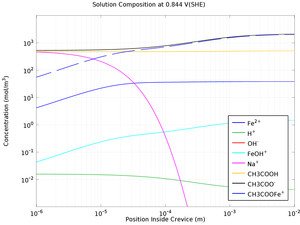
Mass transport limitations within thin crevices can often result in the local electrochemistry to differ significantly between the crevice opening (mouth) and end (tip), and as a result of the differences in local chemistry, corrosion may occur. This example models crevice corrosion of ... En savoir plus
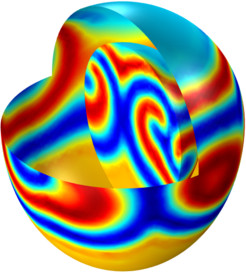
Modeling the electrical activity in cardiac tissue is an important step in understanding the patterns of contractions and dilations in the heart. The heart produces rhythmic electrical pulses, which trigger the mechanical contractions of the muscle. A number of heart conditions involve ... En savoir plus


