
La Bibliothèque d'Applications présente des modèles construits avec COMSOL Multiphysics pour la simulation d'une grande variété d'applications, dans les domaines de l'électromagnétisme, de la mécanique des solides, de la mécanique des fluides et de la chimie. Vous pouvez télécharger ces modèles résolus avec leur documentation détaillée, comprenant les instructions de construction pas-à-pas, et vous en servir comme point de départ de votre travail de simulation. Utilisez l'outil de recherche rapide pour trouver les modèles et applications correspondant à votre domaine d'intérêt. Notez que de nombreux exemples présentés ici sont également accessibles via la Bibliothèques d'Applications intégrée au logiciel COMSOL Multiphysics® et disponible à partir du menu Fichier.

Micromixers can either be static or dynamic depending on the required mixing time and length scale. For static mixers, the Reynolds number has to be suitable high to induce turbulence enhanced mixing. Often micromixers operate in the laminar flow regime due to their small characteristic ... En savoir plus
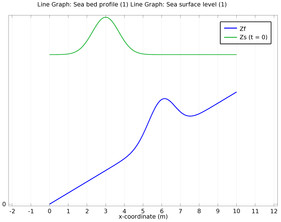
The Shallow Water equations are frequently used for modeling both oceanographic and atmospheric fluid flow. Models of such systems lead to the prediction of areas eventually affected by pollution, coast erosion and polar ice-cap melting. Comprehensive modeling of such phenomena using ... En savoir plus
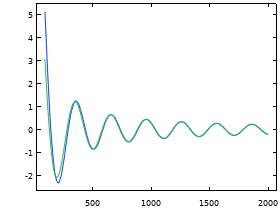
In this tutorial model, the far-field radiation pattern of a dipole antenna is computed in a 2D axisymmetric model component. Then, in a separate 3D model component, a ray is released using the far-field radiation pattern to initialize the ray's intensity, polarization, and phase. En savoir plus
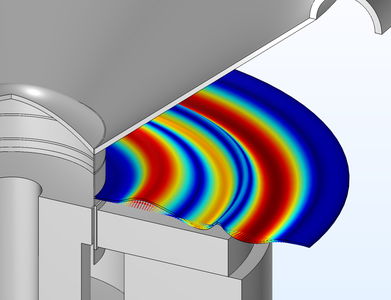
The suspension of a loudspeaker is designed to keep the membrane in place and avoid any rocking movement of the voice coil. At low frequencies, where the displacement of the membrane is significant, the stiffness of the suspension varies along the movement of the voice coil. This ... En savoir plus
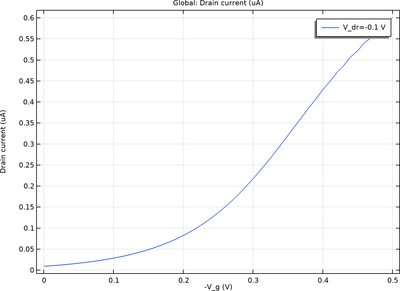
This model shows how to model an electrolyte-gated organic field-effect transistor based on a general drift–diffusion model. The model uses the Transport of Charge Carriers interface and the Electrostatics interface. The transistor characteristics are visualized. Formation of the EDLs in ... En savoir plus
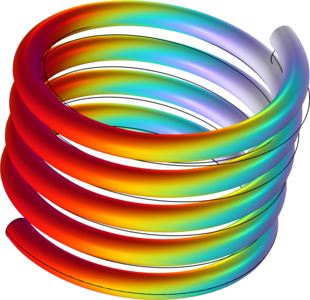
Global equations are a way of adding an additional equation to a model. A global equation can be used to describe a load, constraint, material property, or anything else in the model that has a uniquely definable solution. In this example, a structural mechanics model of a spring is ... En savoir plus
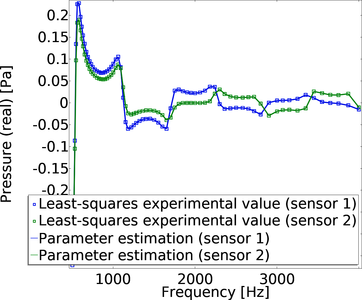
Impedance tubes are used for estimating the surface impedance of various samples, for example, a layer of porous material used for sound insulation. This model shows how the five material parameters of the Johnson-Champoux-Allard model can be estimated from the pressure at two ... En savoir plus
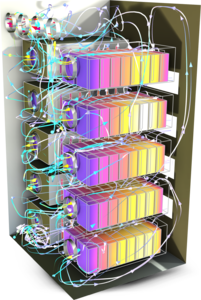
Tutorial model of an air-cooled battery energy storage system (BESS). The model includes conjugate heat transfer with turbulent flow, fan curves, internal screens, and grilles. It features several interesting aspects: Fully parameterized geometry, which can be modified for different ... En savoir plus


