
La Bibliothèque d'Applications présente des modèles construits avec COMSOL Multiphysics pour la simulation d'une grande variété d'applications, dans les domaines de l'électromagnétisme, de la mécanique des solides, de la mécanique des fluides et de la chimie. Vous pouvez télécharger ces modèles résolus avec leur documentation détaillée, comprenant les instructions de construction pas-à-pas, et vous en servir comme point de départ de votre travail de simulation. Utilisez l'outil de recherche rapide pour trouver les modèles et applications correspondant à votre domaine d'intérêt. Notez que de nombreux exemples présentés ici sont également accessibles via la Bibliothèques d'Applications intégrée au logiciel COMSOL Multiphysics® et disponible à partir du menu Fichier.
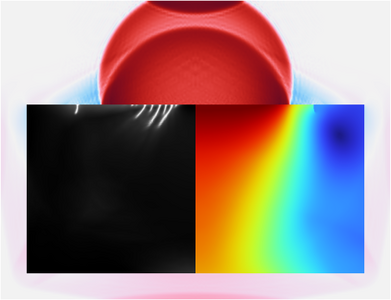
An acoustic point source emits a pressure wave in water that travels toward a piece of glass. Cracks are formed and propagate due to high tensile stresses developed in the glass. A fully coupled acoustic-structure interaction problem including phase field damage in solids is solved in ... En savoir plus
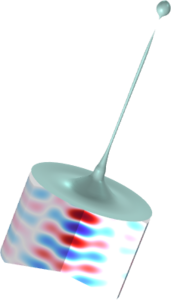
Acoustic droplet ejection is a non-contact, highly controllable method for liquid handling emerging in applications such as printing, biomedical, semiconductor assembly, and mass spectroscopy. The modeling approach assumes separation of acoustic and flow time scales. First, a focused ... En savoir plus
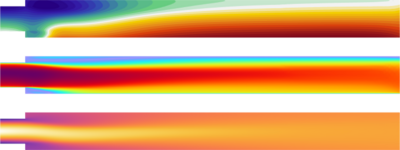
Turbulent flow, Elliptic Blending R-ε interface is used to analyze fully developed turbulent flow in a spanwise rotating channel. Due to the influence of Coriolis force on turbulence, profiles of the flow variables are skewed at moderate rotation rate. The asymmetry between cyclonic ... En savoir plus
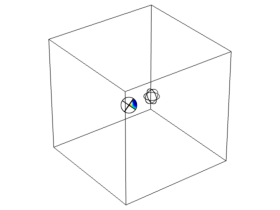
This model verifies that the onset of streamer formation between two spheres separated by atmospheric pressure dry air at a distance of 2cm occurs at 51.8kV. The electrical breakdown is detected by integrating Townsend coefficients along the electric field lines between the two spheres. ... En savoir plus

A plane-wave mode feeds an axisymmetric horn radiating from an infinite baffle toward an open half space. The radius of the waveguide attached to the horn throat is assumed to be fixed, as well as the depth of the horn and the size of the horn mouth attached to the baffle. By varying the ... En savoir plus

This model analyzes the scattering of a plane propagating modulated Gaussian pulse off a submarine hull. The scattered field and the spatial response are also determined. The model uses the Pressure Acoustics, Time Explicit interface to model this large acoustic model in the time domain. ... En savoir plus
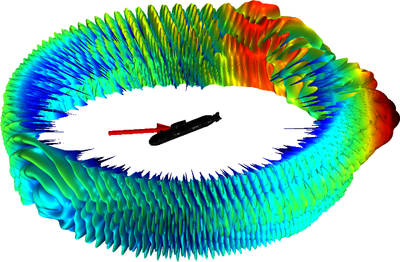
The primary defense of a submarine lies in its capacity to remain hidden during operation. As radio waves are strongly absorbed by seawater, sound navigation ranging, or sonar, is one of the main methods used for the detection of submarines. Sonar systems are also used for underwater ... En savoir plus
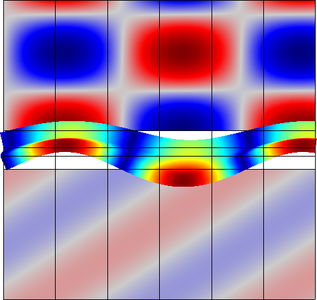
In this model, two fluids are separated by a multilayer solid elastic structure. An acoustic pressure wave impacts the structure resulting in a reflected wave and a transmitted wave with a loss through the structure. This model investigates the transmission loss through the structure. ... En savoir plus

Graphene, carbon atoms arranged in a two-dimensional hexagonal lattice has sparked tremendous research and application interests since its experimental discovery about two decades ago. Besides being ultrathin, this material exhibits a plethora of interesting properties, including high ... En savoir plus
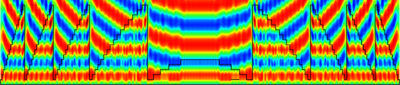
This model simulates a 16-level, first-order, focusing Fresnel lens with 50 µm diameter and 150 µm focal length. In one simulation, the Electromagnetic Waves, Frequency Domain interface computes the electric field in the Fresnel lens and the surrounding air domain extended to the focal ... En savoir plus


