
La Bibliothèque d'Applications présente des modèles construits avec COMSOL Multiphysics pour la simulation d'une grande variété d'applications, dans les domaines de l'électromagnétisme, de la mécanique des solides, de la mécanique des fluides et de la chimie. Vous pouvez télécharger ces modèles résolus avec leur documentation détaillée, comprenant les instructions de construction pas-à-pas, et vous en servir comme point de départ de votre travail de simulation. Utilisez l'outil de recherche rapide pour trouver les modèles et applications correspondant à votre domaine d'intérêt. Notez que de nombreux exemples présentés ici sont également accessibles via la Bibliothèques d'Applications intégrée au logiciel COMSOL Multiphysics® et disponible à partir du menu Fichier.
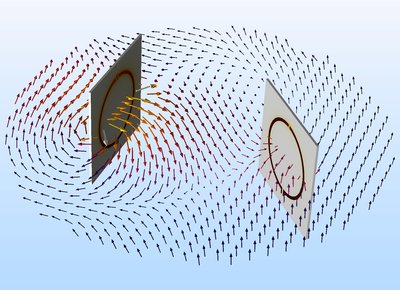
This model addresses the concept of wireless power transfer by studying the energy coupling between two circular loop antennas tuned for UHF RFID frequency whose size is reduced using chip inductors. The circular loop antenna provides inherent inductive coupling by its shape, and it can ... En savoir plus
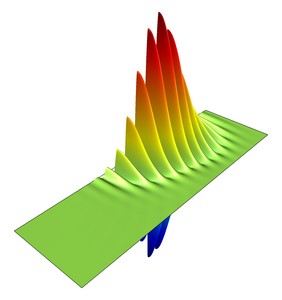
Laser systems are an important application area in modern electronics. With nonlinear materials it is possible to generate harmonics that are a multiple of the frequency of the laser light. This model shows how a second harmonic generation can be set up as a transient wave simulation, ... En savoir plus
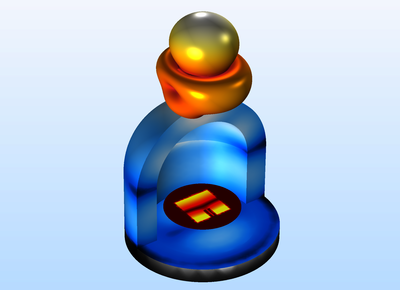
A radome minimizes losses and improves radiation characteristics of an antenna through its design. The structure can be optimized to minimize the transmission loss and also designed to improve radiation characteristics including antenna directivity and side lobes. Shown in the model is ... En savoir plus
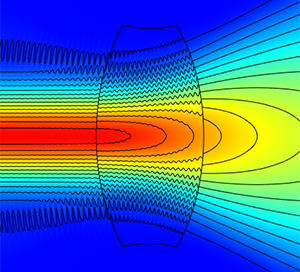
In this example, the properties of an engineeredmaterial are modeled by a spatially varying dielectric distribution. Specifically, a convex lens shape is defined via a known deformation of a rectangular domain. The dielectric distribution is defined on the undeformed, original ... En savoir plus
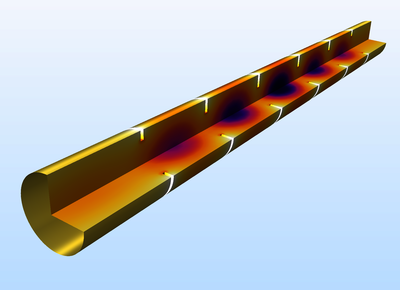
A circular waveguide filter is designed using a 2D axisymmetric model. Six annular rings added to the waveguide form circular cavities connected in series, and each cavity cutoff frequency is close to the center frequency of the filter. The simulated S-parameters show a bandpass ... En savoir plus
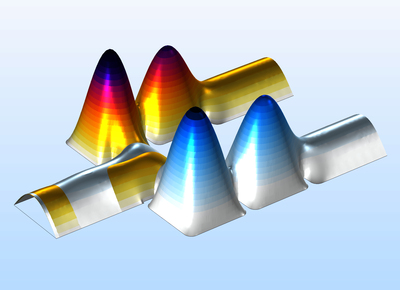
A diplexer is a device that combines or splits signals into two different frequency bands, widely used in mobile communication systems. This model simulates splitting properties using a simplified 2D geometry. The computed S-parameters and electric fields at the lower and upper bands ... En savoir plus
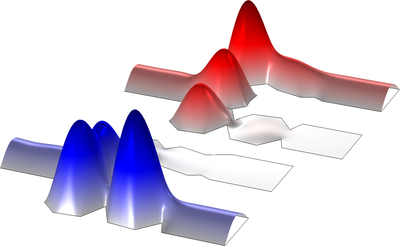
A diplexer is a device that combines or splits signals into two different frequency bands, widely used in mobile communication systems. This example simulates splitting properties using a simplified 2D geometry. The geometry is optimized using shape optimization in order to get the ... En savoir plus
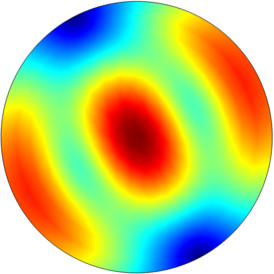
In mode analysis it is usually the primary goal to find a propagation constant. This quantity is often, but not always, real valued; if the analysis involves some lossy part, such as a nonzero conductivity or an open boundary, the eigenvalue is complex. In such situations, the real and ... En savoir plus
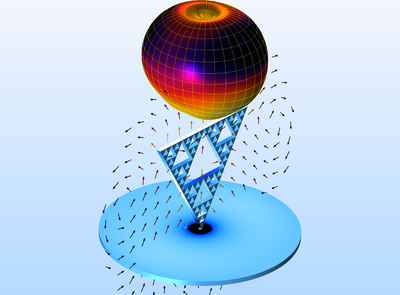
A fractal is a mathematical form showing self-repeating patterns. By virtue of its geometrical properties, a fractal structure can generate multiple resonances in RF applications. This antenna model uses a 3rd order Sierpinski triangle and the calculated S-parameters shows good input ... En savoir plus
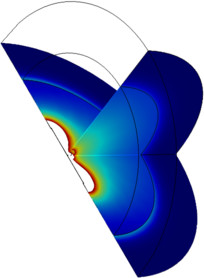
Feeding antennas with proper signals can be difficult. The signal is often described as a voltage, and voltages are not well defined in electromagnetic wave formulations. There are several tricks to model voltage generators in such situations, and one is the magnetic frill. This model ... En savoir plus


