
La Bibliothèque d'Applications présente des modèles construits avec COMSOL Multiphysics pour la simulation d'une grande variété d'applications, dans les domaines de l'électromagnétisme, de la mécanique des solides, de la mécanique des fluides et de la chimie. Vous pouvez télécharger ces modèles résolus avec leur documentation détaillée, comprenant les instructions de construction pas-à-pas, et vous en servir comme point de départ de votre travail de simulation. Utilisez l'outil de recherche rapide pour trouver les modèles et applications correspondant à votre domaine d'intérêt. Notez que de nombreux exemples présentés ici sont également accessibles via la Bibliothèques d'Applications intégrée au logiciel COMSOL Multiphysics® et disponible à partir du menu Fichier.
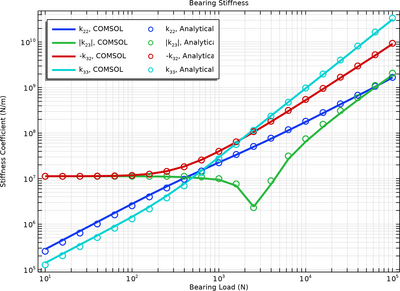
When analyzing rotors, it is common that bearings are modeled through their effective dynamic coefficients about a static equilibrium position. This model illustrates how to compute such coefficients for a cylindrical journal bearing. The bearing length is kept much smaller than its ... En savoir plus

In this tutorial model, a step thrust bearing is topology optimized to maximize the bearing capacity. A step thrust bearing consists of a stepped bearing surface on which the end of the shaft rotates. The entire assembly is submerged in a lubricant. The shaft collar is assumed to be ... En savoir plus
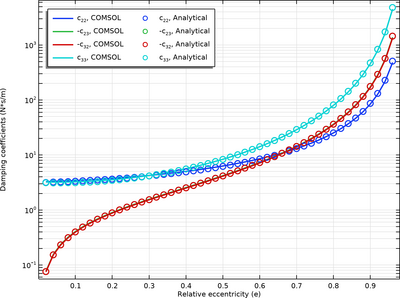
Squeeze film dampers are components that provide additional damping to rotating machines. To simplify the modeling of a rotor assembly, squeeze film dampers are modeled in terms of their damping coefficients which are a functions of the journal location in the damper. This model computes ... En savoir plus
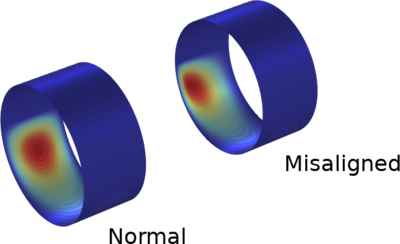
In this example, a rotor supported by two hydrodynamic bearings is analyzed. An eccentric disk located between the bearings induces rotor whirl. One of the bearings is misaligned with the rotor axis. The Beam Rotor interface with Hydrodynamic Bearing interface in the Rotordynamics ... En savoir plus
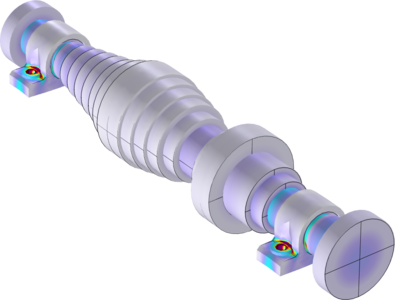
Hydrodynamic bearings generate heat due to the viscous losses in the lubricant. As a result, the temperature of the rotor increases, causing deformation and thermal stresses in both the rotor and the bearing housing. This example shows how to model different physical phenomena involved ... En savoir plus
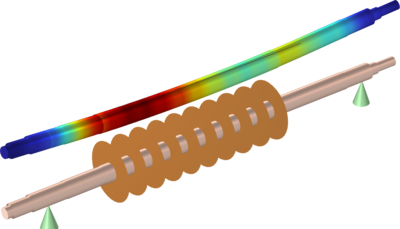
The fluid flow in seals causes a strong restoring radial force, opposing the shaft motion. Also, there is a cross-coupled force due to the axial variation of the circumferential flow. The first type of force always has a stabilizing effect on the rotor, whereas the second one can cause ... En savoir plus
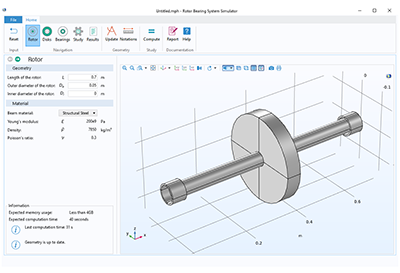
This app demonstrates the following: Navigation system using toggle buttons in the ribbon and Back/Forward buttons in the settings window Selecting predefined or user-defined materials Using a table for input of geometry objects The app simulates a rotor bearing system consisting of ... En savoir plus
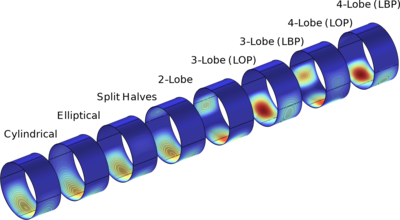
This example demonstrates how modeling can be used to investigate the performance of different hydrodynamic journal bearings. The model uses the Hydrodynamic Bearing interface, which solves the Reynolds equation to compute the pressure developed in a thin fluid film for four bearing ... En savoir plus


