
La Bibliothèque d'Applications présente des modèles construits avec COMSOL Multiphysics pour la simulation d'une grande variété d'applications, dans les domaines de l'électromagnétisme, de la mécanique des solides, de la mécanique des fluides et de la chimie. Vous pouvez télécharger ces modèles résolus avec leur documentation détaillée, comprenant les instructions de construction pas-à-pas, et vous en servir comme point de départ de votre travail de simulation. Utilisez l'outil de recherche rapide pour trouver les modèles et applications correspondant à votre domaine d'intérêt. Notez que de nombreux exemples présentés ici sont également accessibles via la Bibliothèques d'Applications intégrée au logiciel COMSOL Multiphysics® et disponible à partir du menu Fichier.
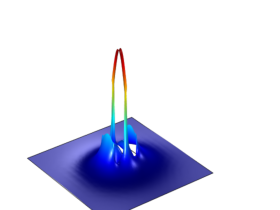
The model analyses the mode propagation within a nano slot waveguide. In a slot waveguide configuration, two high refractive index slabs (~3.48) are placed adjacent to the low refractive index slot (~1.44). Mode analysis was performed on a 2D cross section of a slot waveguide for an ... En savoir plus
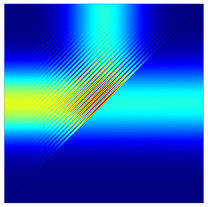
A beam splitter is used to split a single beam of light into two. One way of making a splitter is to deposit a thin layer of metal between two glass prisms. The beam is slightly attenuated within the layer, and split into two paths. In this example, the thin metal layer is modeled using ... En savoir plus
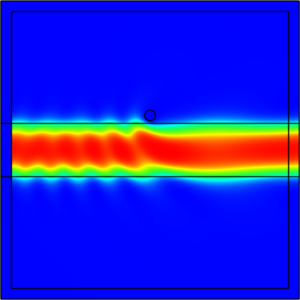
This model includes a dielectric slab waveguide with a small lossy metallic object nearby. The object causes light to be scattered, absorbed, and both reflected and transmitted along the waveguide. Learn more in this accompanying blog post: Modeling a Scatterer Near an Optical Waveguide En savoir plus
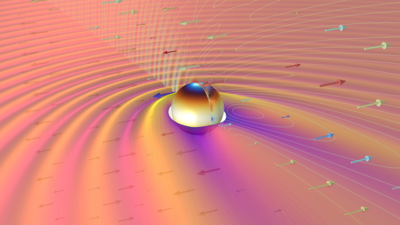
This verification model uses the Electromagnetic Waves, Boundary Elements interface to simulate the RCS of perfectly conducting sphere. The simulated result is compared to analytical calculation to verify the accuracy. En savoir plus
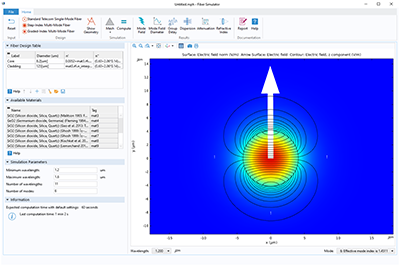
The transmission speed of optical waveguides is superior to microwave waveguides because optical devices have a much higher operating frequency than microwaves, enabling a far higher bandwidth. Single-mode step-index fibers are used for long-haul (even transoceanic) communication, ... En savoir plus
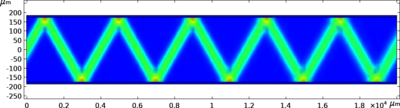
The bidirectional formulation of the Beam Envelopes interface can be used not only for counter-propagating wave simulations but also for waves propagating to up to two directions. In this model, an almost collimated Gaussian beam is excited at the left boundary and exhibits total ... En savoir plus
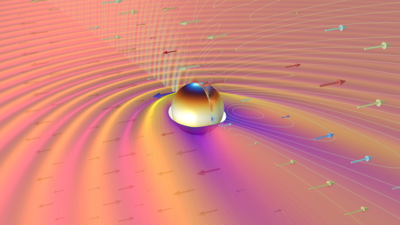
This model illustrates the process of evaluating the radar cross section (RCS) of a metallic sphere through the utilization of the boundary element method (BEM). By taking advantage of a vertical symmetry plane that is parallel to the polarization of an incident background field, the ... En savoir plus
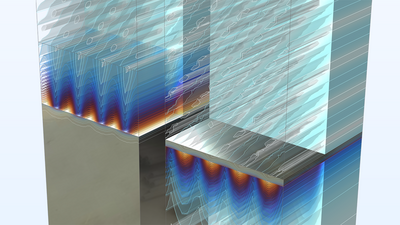
This example demonstrates a simulation setup for exciting surface plasmon polaritons using Otto and Kretschmann configurations. The underlying mechanism is enabled by the interplay between total internal reflection and evanescent-wave coupling phenomena. It also calculates the ... En savoir plus


