
La Bibliothèque d'Applications présente des modèles construits avec COMSOL Multiphysics pour la simulation d'une grande variété d'applications, dans les domaines de l'électromagnétisme, de la mécanique des solides, de la mécanique des fluides et de la chimie. Vous pouvez télécharger ces modèles résolus avec leur documentation détaillée, comprenant les instructions de construction pas-à-pas, et vous en servir comme point de départ de votre travail de simulation. Utilisez l'outil de recherche rapide pour trouver les modèles et applications correspondant à votre domaine d'intérêt. Notez que de nombreux exemples présentés ici sont également accessibles via la Bibliothèques d'Applications intégrée au logiciel COMSOL Multiphysics® et disponible à partir du menu Fichier.
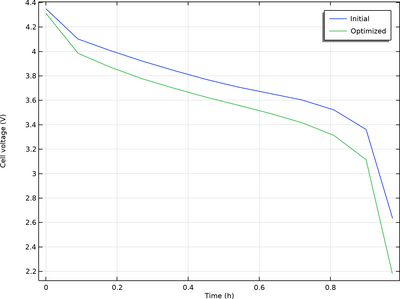
This model demonstrates how gradient-based optimization can be used to find the design parameters that maximize the energy output of a lithium-ion battery for a constant 1C discharge. The example optimizes three parameters: the positive electrode's thickness and the active electrode ... En savoir plus
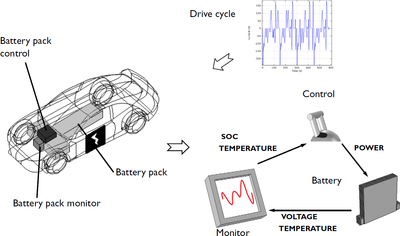
This application shows how a battery cell exposed to a hybrid electric vehicle drive cycle can be investigated with the Lithium-Ion Battery interface in COMSOL. This model predicts the battery behavior to make comparisons of the monitored properties. They can be used to understand the ... En savoir plus
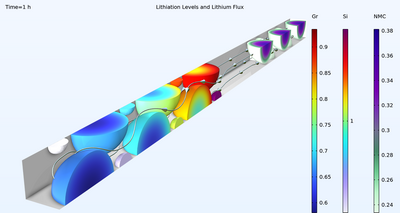
This model describes the behavior of a lithium-ion battery unit cell modeled using an idealized heterogeneous three-dimensional geometry. In contrast to the typical homogenized approach for describing porous electrodes, heterogeneous models define the actual shapes of the electrode ... En savoir plus
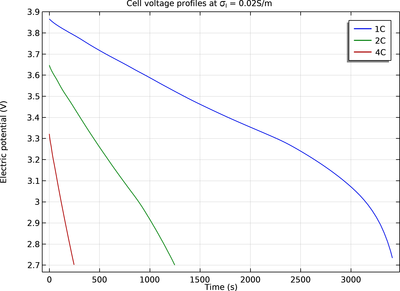
This example demonstrates the Lithium-Ion Battery, Single-Ion Conductor interface for studying the discharge of a lithium-ion battery with solid electrolyte. The geometry is in one dimension and the model is isothermal. The behavior at various discharge currents and solid electrolyte ... En savoir plus
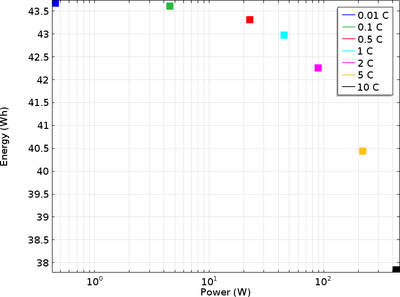
A battery’s possible energy and power outputs are crucial to consider when deciding in which type of device it can be used. A cell with high rate capability is able to generate a considerable amount of power, that is, it suffers from little polarization (voltage loss) even at high ... En savoir plus
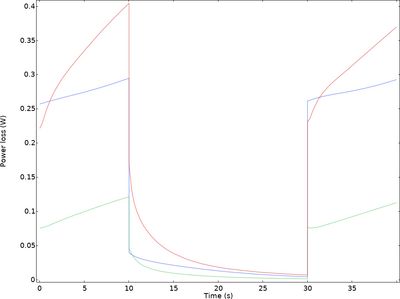
This example computes the power losses in a lithium-ion battery when exposed to high current pulses in a hybrid pulse power characterization (HPPC) test. Power loss contributions stemming from different phenomena are analyzed, as well as the total power losses pertaining to the ... En savoir plus
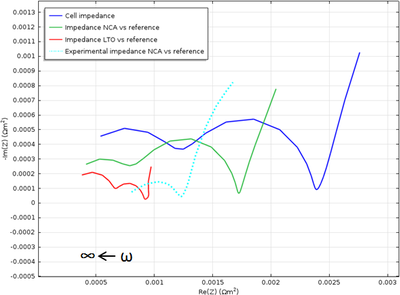
The goal with this app is to explain experimental electrochemical impedance spectroscopy (EIS) measurements and to show how you can use a simulation app, along with measurements, to estimate the properties of lithium-ion batteries. The app takes measurements from an EIS experiment and ... En savoir plus
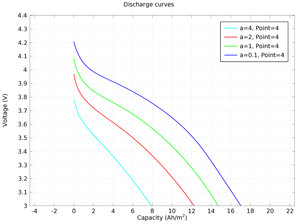
This model demonstrates the Lithium-Ion Battery interface for studying the discharge and charge of a lithium-ion battery for a given set of material properties. The geometry is in one dimension and the model is isothermal. Battery developers can use the model to investigate the influence ... En savoir plus


