
Lorenzo Bortot, CERN, Switzerland
Engineers and physicists at CERN go to great lengths to ensure that the high-power superconducting magnets that maintain the circular trajectory of particles inside the Large Hadron Collider (LHC) do not revert to a resistive state, an event known as a quench. To understand and prevent quench events, Lorenzo Bortot, an electrical engineer and research fellow at CERN, used numerical simulation to develop a multiphysics, multiscale, and multirate representation of the electrodynamics and thermal evolution of a quench event.
Suggested Stories
Simulations for Solar
Engineers at EMIX use numerical analysis to characterize and optimize all aspects of design for the manufacture of ...
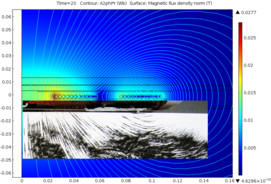
Multiphysics Simulation Helps Miele to Optimize Induction Stove Designs
The induction stove was designed to meet a consumer need for better precision and speed than traditional stoves. ...
The Sound of Perfection Thanks to the Modeling of Acoustic Metasurfaces
At the École Polytechnique Fédérale de Lausanne (EPFL), engineers have designed an acoustic metasurface that could be ...
Application Builder and COMSOL Server: A Review
William Vetterling, research fellow and manager of the Image Science Laboratory at Zink Imaging, created an intuitive ...


