
Lorenzo Bortot, CERN, Switzerland
Engineers and physicists at CERN go to great lengths to ensure that the high-power superconducting magnets that maintain the circular trajectory of particles inside the Large Hadron Collider (LHC) do not revert to a resistive state, an event known as a quench. To understand and prevent quench events, Lorenzo Bortot, an electrical engineer and research fellow at CERN, used numerical simulation to develop a multiphysics, multiscale, and multirate representation of the electrodynamics and thermal evolution of a quench event.
Suggested Stories
Simulation Advances the Design of a Microfluidic Therapeutic Cell Sorter
The Technology Partnership (TTP), a firm that consults on technology development, created a vortex-actuated cell ...
Forecasting Fruit Freshness with Simulation Apps
Swiss research organization Empa built multiphysics models and compiled a simulation application that feeds results ...
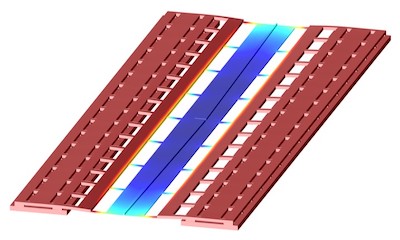
Designing a Silicon Photonic MEMS Phase Shifter with Simulation
Researchers at the Swiss Federal Institute of Technology Lausanne are using simulation to optimize the optical and ...
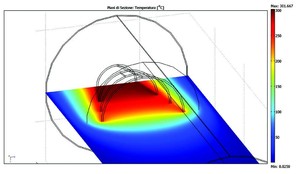
Around the Clock Solar Power
Italian utility ENEL and the Italian National Agency for New Technologies joined together to develop a new kind of ...


