
Lorenzo Bortot, CERN, Switzerland
Engineers and physicists at CERN go to great lengths to ensure that the high-power superconducting magnets that maintain the circular trajectory of particles inside the Large Hadron Collider (LHC) do not revert to a resistive state, an event known as a quench. To understand and prevent quench events, Lorenzo Bortot, an electrical engineer and research fellow at CERN, used numerical simulation to develop a multiphysics, multiscale, and multirate representation of the electrodynamics and thermal evolution of a quench event.
Suggested Stories
Voxelgrids Pioneers Accessible MRI Technology Through Virtual Analysis
Voxelgrids Innovations developed India's first locally made MRI scanner, which was specifically designed to be more ...

Améliorer les perspectives de la géothermie avec les forages inclinés
Les échangeurs géothermiques utilisent des forages pour extraire l'énergie du sous-sol afin de chauffer et de ...
Keeping LEDs Cool Gets More Manageable Through Simulation
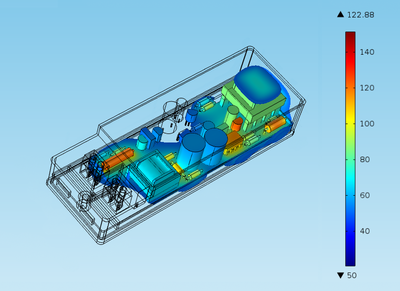
Light-emitting diodes (LEDs) offer many benefits over incandescent lighting, such as long life spans and high luminous ...
Conjugate Heat Transfer
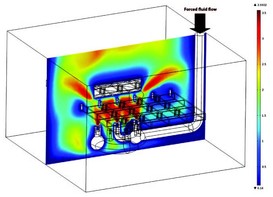
This is an application brief describing the concept of Conjugate Heat Transfer, which is important in many industrial ...


