
NEXT ENERGY Analyzes Heat Transfer in Lithium-Ion Batteries
Gerd Liebig, Pamina Bohn, NEXT ENERGY EWE Research Centre for Energy Technology, Germany
Lithium-ion batteries, which have a tendency to degrade at high temperatures, must adhere to stringent regulations guaranteeing their ability to withstand operating temperature fluctuations. Researchers at NEXT ENERGY used heat transfer modeling to study whether high welding temperatures can create enough temperature propagation within cells to cause irreversible damage, such as electrolyte decomposition and capacity loss. They discovered that tab welding can, in fact, induce irreversible damage, but laser welding is significantly less detrimental.
Suggested Stories
Keynote: Using COMSOL Multiphysics® for Circuit Board Thermal Analysis
The aerospace and defense industry requires stronger circuit boards than those needed for everyday electronics due to ...
Inspiring Young Engineers to Design for the Future at EPFL
EPFLoop, from the Swiss Federal Institute of Technology Lausanne (EPFL), designed their pod for the 2018 SpaceX ...
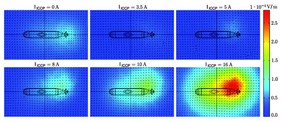
Submarines: Corrosion Protection or Enemy Detection?
Submarines create underwater electric potential (UEP) signatures when using corrosion protection systems. These ...
Life Sciences Company Accelerates Biopharmaceutical R&D with a Dedicated CAE Department
Biopharmaceuticals are expensive to develop due to their complex molecular structure, the specialized manufacturing ...


