
M. Bachmann, V. Avilov, A. Gumenyuk, and M. Rethmeier
BAM Federal Institute For Materials Research and Testing
Germany
High-power laser beam welding uses a localized heat source to achieve narrow deep welds and high welding rates. Engineers run into some difficulties because the use of a localized heat source often results in the distortion of metal components; spattering and the ejection of droplets from the weld pool results in underfills, undercuts, craters, blowholes, or blowouts.
A stationary magnetic field is applied to the laser welding process to improve its quality and counteract effects such as spattering. BAM Federal Institute For Materials Research and Testing in Germany are working to improve the quality of high-power laser beam welding using COMSOL Multiphysics. To model and simulate the laser beam welding, heat transfer, fluid dynamics, and electromagnetics were coupled and solved. This allowed BAM to accurately model the process by including Marangoni effects, gravity, latent heats of fusion, and Lorentz forces.
Suggested Stories
Boost Sales and Build Stronger Relationships with the Deployment of Simulation Apps
Proofs of concept are often the deciding factor in gaining the trust of a customer and generating a sale. But for high ...
Optimizing Screen Protection During the Manufacturing Process
Cover glass, the screen surface material used for tablets and cell phones, offers exceptional smoothness, a mark-free ...
Industrial Applications of Carbon and Graphite for Thermal Management
At GrafTech International, engineers develop carbon and graphite products for applications from consumer electronics ...
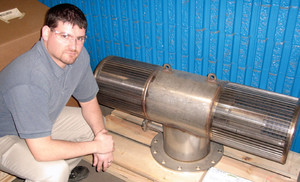
The Science of Water Screening
Johnson Screens® are the manufacturers of steel screens that impede debris from lakes and rivers from entering pipes ...


