
The Colorado School of Mines Uses Simulation to Track Fluid Movement
A. Haas, H. Mahardika, M. Karaoulis, and A. Revil
Colorado School of Mines, USA
Combining acoustic and electromagnetic analyses helps scientists to more efficiently measure and survey subterranean regions. Acoustic waves can travel long distances, but have limitations when it comes to providing details about formation properties, and cannot be used to identify the liquids flowing through them. Electromagnetic waves do not propagate as far as acoustic waves, but can identify and track the flow of pore water. Combining these methods makes the process easier in particular for scientists who track fracking fluids underground.
The Colorado School of Mines has created a system for locating fracking fluids by finding subsurface electromagnetic disturbances that occur based on the kinds of formations the water passes through. They wanted to simulate fracking events and produce synthetic seismograms and electrograms with the help of simulation. By linking COMSOL Multiphysics and MATLAB®, they designed a laboratory experiment in which they repeatedly hydraulically-fractured a porous cement cube by pumping in saline water under high pressure.
Suggested Stories
Engineering Perfect Puffed Snacks
The production of puffed rice, like many other types of food, is incredibly complicated and involves multiple ...
Keynote: Electrochemical Modeling for Optimized Operating Strategies and Development of Automotive Cells
In this keynote talk from COMSOL Day: Battery Design, Nikolaos Papadopoulos of Porsche discusses how he is using ...
Amener la simulation multiphysique sur les chantiers de construction
Le temps, la température, le choix des matériaux, les conditions météorologiques ou encore la technique de coulée sont ...
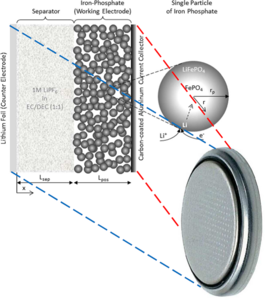
Highly Accurate Li-ion Battery Simulation
Battery management systems (BMSs) are designed to protect the batteries and predict their charge level. They use ...


