
Using Simulation to Rapidly and Precisely Model Nanoresonators
J. Yang, M. Perrin, P. Lalanne
CNRS, France
Nanoresonators, or optical nanoantennas, manage the concentration, radiation, and absorption of light at the nanometer scale and show stunning promise for future improvements to technology, such as sensors, computers, and other electronics. However, the ways that these devices scatter light and interact with their surrounding environment are not well understood, nor are the electromagnetic properties of the complex metal shapes that comprise them. Numerical approaches to calculating the resonance modes and excitations in nanoresonators have historically been cumbersome and error-prone.
Now, researchers and engineers at Institut d’Optique d’Aquitaine (Paris, France) are using COMSOL Multiphysics simulations to rapidly and precisely determine physical properties, calculate the resonance modes, and analyze the electromagnetic fields and scattering that occur due to excitation. They expect that their new approach to modeling these nanoresonators will lead to advancements in the development and use of nanoelectromechanical devices (NEMS) for a wide range of applications such as photovoltaics, spectroscopy, and improved electronic systems.
Suggested Stories
It’s a Bird, It’s a Plane: Flow Patterns around an Oscillating Piezoelectric Fan Blade
As electronics grow smaller and smaller and are used for extensive periods of time, their internal heat loads are ...
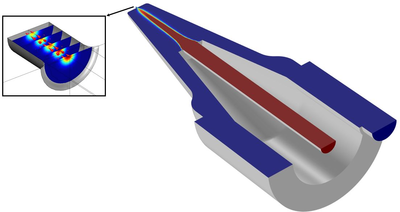
Optimizing Hematology Analysis: When Physical Prototypes Fail, Simulation Provides the Answers
Hematology analysis, the analysis of a blood sample to determine a variety of hematological parameters, is a major ...
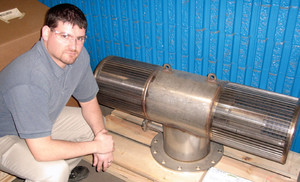
The Science of Water Screening
Johnson Screens® are the manufacturers of steel screens that impede debris from lakes and rivers from entering pipes ...
Let There Be Light: A Brighter Future for OLEDs
As the demand for lightweight and flexible electronics continues to increase, so does the demand for lightweight and ...


