
Using Simulation to Rapidly and Precisely Model Nanoresonators
J. Yang, M. Perrin, P. Lalanne
CNRS, France
Nanoresonators, or optical nanoantennas, manage the concentration, radiation, and absorption of light at the nanometer scale and show stunning promise for future improvements to technology, such as sensors, computers, and other electronics. However, the ways that these devices scatter light and interact with their surrounding environment are not well understood, nor are the electromagnetic properties of the complex metal shapes that comprise them. Numerical approaches to calculating the resonance modes and excitations in nanoresonators have historically been cumbersome and error-prone.
Now, researchers and engineers at Institut d’Optique d’Aquitaine (Paris, France) are using COMSOL Multiphysics simulations to rapidly and precisely determine physical properties, calculate the resonance modes, and analyze the electromagnetic fields and scattering that occur due to excitation. They expect that their new approach to modeling these nanoresonators will lead to advancements in the development and use of nanoelectromechanical devices (NEMS) for a wide range of applications such as photovoltaics, spectroscopy, and improved electronic systems.
Suggested Stories
Illuminating Complex Material Behavior with Multiphysics Simulation
At Canadian Nuclear Laboratories, multiphysics simulation is used to gain insight into the behavior of nuclear fuel ...
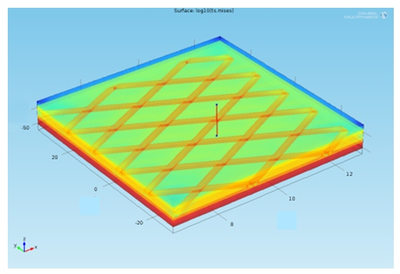
Boeing Simulates Thermal Expansion in Composites with Expanded Metal Foil for Lightning Protection of Aircraft Structures
Carbon fiber composites are used extensively throughout the body of modern aircraft, such as the Boeing 787 ...
Precision Performance: The Pursuit of Perfect Measurement
Brüel & Kjær, a manufacturer of transducers, microphones, and other instruments and software for sound and ...
Keynote: Democratizing In Silico Ablation R&D via Simulation Apps
In this keynote talk from COMSOL Day: MedTech, Marcela Mercado Montoya of IN SILICO STEM introduces the capabilities ...


