
Toyota Improves Electronic Component Cooling with Simulation
Toyota Research Institute of North America, MI, USA
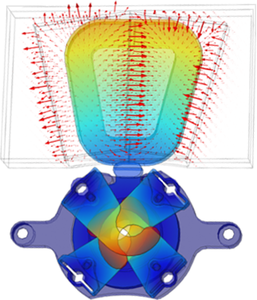
The Toyota Research Institute in Ann Arbor drives cutting-edge research in energy efficiency, mobility infrastructure, and safety. Here, Ercan Dede and his team are designing heat sinks (or cold plates), which are affixed to fragile electrical systems and other applications in Toyota’s hybrid vehicles.
Their simulations simulate the cold plate’s topology for improved cooling efficiency while minimizing pressure drop. Previous designs provided good heat transfer, but at the cost of significant pressure drops across the plate. Making use of branching channels, the heat sinks provide the same heat transfer but with an optimized flow path. Using LiveLinkTM for SolidWorks®, they were able to create fast and accurate design iterations, leading to an optimal cold plate topology.
SolidWorks is a registered trademark of Dassault Systèmes SolidWorks Corp.
Suggested Stories
Multiphysics Analysis Helps Preserve the Past
Jos van Schijndel is the founder of Netherlands-based consulting firm CompuToolAble and assistant professor at ...
Keeping Cool: SRON Develops Thermal Calibration System for Deep-Space Telescope
Deep-space telescopes require ultrasensitive detectors and calibration to pick up weak far-infrared signals. The SpicA ...
Addressing Oil Spill Cleanup Using Hydrophobic Meshes
Engineers at Amphos 21 tested a new solution for different oil spill scenarios, hydrophobic meshes, with numerical ...
Get an Inside Look at How Samsung Uses Acoustics Simulations
Step into the state-of-the-art Samsung Audio Lab to see how they develop loudspeakers, soundbars, and other audio ...


