
F. Curtis, J.D. Freels
Oak Ridge National Lab, TN, USA
In response to the increasing awareness of the risks associated with the proliferation of nuclear materials, the Global Threat Reduction initiative has called for research reactors currently using highly enriched uranium (HEU) fuel to be converted to low-enriched uranium (LEU) fuel. The High Flux Isotope Reactor (HFIR), located at Oak Ridge National Laboratory (ORNL), is one such reactor that uses HEU fuel.
Using multiphysics simulation, ORNL engineers are conducting researching and working toward a new design for the HFIR that will preserve the reactor's performance, minimize negative effects on operation efficiency, and ensure reactor safety once the reactor’s fuel has been converted. This process requires that highly accurate multiphysics analyses be conducted into the fluid-structure interaction (FSI) of the reactor’s fuel plates and that an understanding of how the new density of the LEU fuel will impact reactor performance is achieved. ORNL researchers developed a model of the fuel plate deflections in COMSOL Multiphysics that they validated against representative tests using core configurations similar to the HFIR. The model will be used to test new design possibilities and eventually help facilitate the reactor's conversion to LEU fuel.
Suggested Stories
Helicon Antenna Supports Nuclear Fusion
Built by engineers at General Atomics, the DIII-D tokamak needs to achieve temperatures that are 10 times hotter than ...
Lightweighting with Aluminum: Corrosion Apps Guide Leading Design
To achieve fuel efficiency goals, conventional materials for car structures, such as structural steel, must be ...
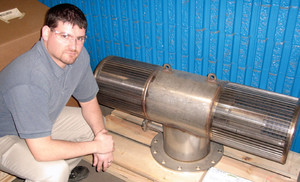
The Science of Water Screening
Johnson Screens® are the manufacturers of steel screens that impede debris from lakes and rivers from entering pipes ...
Better Ways to Heat and Cool Buildings
Adsorptive climate control systems can reduce the power required to heat and cool buildings by running primarily on ...


