
S. Yushanov, J. Crompton, and K. C. Koppenhoefer, Altasim Technologies, OH, USA
When electromagnetic waves propagate through matter, they interact with inhomogeneities and particles that can locally disrupt the electron distribution, causing electromagnetic radiation and scattering. One mathematical model used to describe the scattering of electromagnetic waves is called Mie scattering, which provides a general solution independent of particle size. Examples of phenomena where Mie scattering applies include dust in the air, oil in water, and measuring cell nuclei in biological systems.
In order to model Mie scattering, Maxwell's equations are used to represent the scattered, incident, and internal fields, which are represented by infinite series when solved with an analytical approach. Using COMSOL Multiphysics, AltaSim Technologies has developed a simulation to easily obtain the rates of absorption, scattering, and extinction of electromagnetic energy, and the radiation forces present. They have used a perfectly matched layer (PML), far-field calculations, and surface boundary conditions to calculate the scattered energy. Their computational model contributes to the visualization and understanding of the interactions between particles and incident electromagnetic waves.
Suggested Stories
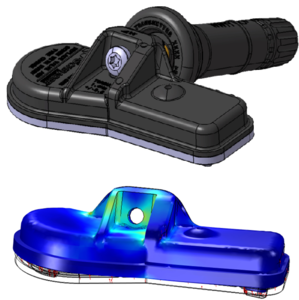
Optimizing Built-in Tire Pressure Monitoring Sensors
Built-in tire pressure sensors need to be able to withstand the wear and tear of working within a car’s tire rim. ...

Modeling Scar Effects in Electrical Spinal Cord Stimulation
The Neuromodulation Group at Lahey Clinic conducted a study based upon spinal cord stimulation (SCS). SCS involves ...
Simulations for Solar
Engineers at EMIX use numerical analysis to characterize and optimize all aspects of design for the manufacture of ...
The Sound of Perfection Thanks to the Modeling of Acoustic Metasurfaces
At the École Polytechnique Fédérale de Lausanne (EPFL), engineers have designed an acoustic metasurface that could be ...


