
La Bibliothèque d'Applications présente des modèles construits avec COMSOL Multiphysics pour la simulation d'une grande variété d'applications, dans les domaines de l'électromagnétisme, de la mécanique des solides, de la mécanique des fluides et de la chimie. Vous pouvez télécharger ces modèles résolus avec leur documentation détaillée, comprenant les instructions de construction pas-à-pas, et vous en servir comme point de départ de votre travail de simulation. Utilisez l'outil de recherche rapide pour trouver les modèles et applications correspondant à votre domaine d'intérêt. Notez que de nombreux exemples présentés ici sont également accessibles via la Bibliothèques d'Applications intégrée au logiciel COMSOL Multiphysics® et disponible à partir du menu Fichier.

This is a benchmark model for an axisymmetric transient thermal analysis. The temperature on the boundaries changes from 0 degrees C to 1000 degrees C at the start of the simulation. The temperature at 190 s from the anlysis is compared with a NAFEMS benchmark solution. En savoir plus
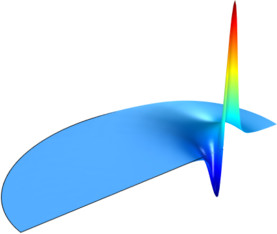
An ellipse with sound-hard walls has the interesting property that an acoustic signal emanating from one of the foci refocuses at the other focal point b/c seconds later, where b (in meters) is the major axis length and c (m/s) is the speed of sound. This model involves a Gaussian ... En savoir plus

This tutorial simulates a standard test and benchmark model for perfectly matched layers (PMLs) as absorbing boundary conditions in the time domain. It involves the propagation of a transient Gaussian pulse with no flow. The Pressure Acoustics, Transient interface is used together with ... En savoir plus
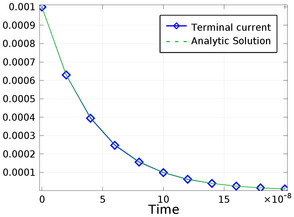
A transient model of a capacitor is solved in combination with an external electrical circuit. The finite element model of the capacitor is combined with a circuit model of a voltage source and a resistor. A step change in voltage is applied, and the transient current through the ... En savoir plus
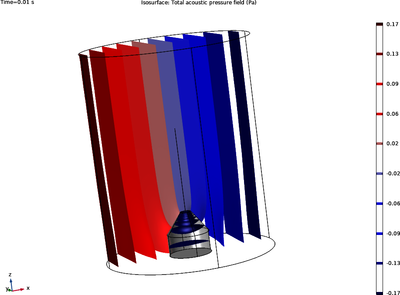
It is often not possible to insert a normal microphone directly into the sound field being measured. The microphone may be too big to fit inside the measured system, such as for in-the-ear measurements for hearing aid fitting. The size of the microphone may also be too large compared to ... En savoir plus
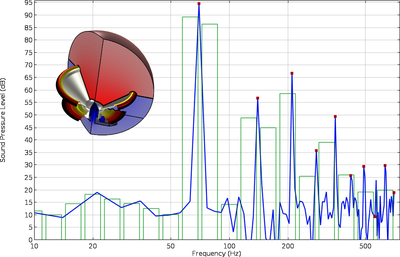
In this model, a full transient analysis of a loudspeaker driver is performed, which allow the modeling of nonlinear effects. It extends the linear frequency domain analysis done in the Loudspeaker Driver tutorial model. The analysis accounts for nonlinear behavior of the soft iron in ... En savoir plus
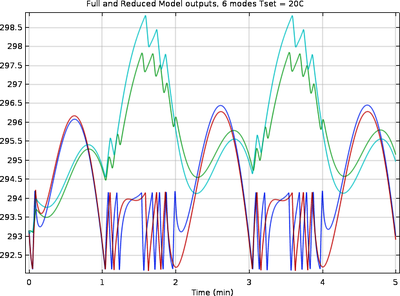
Large FEM simulations can be costly and, if repeated simulations are needed, it can be beneficial to use reduced-order models (ROMs). ROMs are typically valid only in the vicinity of their design conditions and have lower accuracy, but the simulation time is significantly shorter. The ... En savoir plus
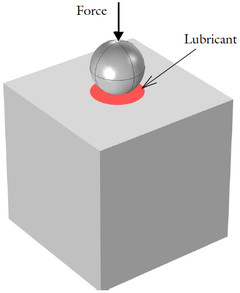
This benchmark model computes the transient pressure distribution and film height in a squeeze film bearing for lubrication in a nonconformal conjunction of a solid sphere and an elastic wall separated by a lubricant film. This model solves the benchmark case of hydrodynamic interaction ... En savoir plus
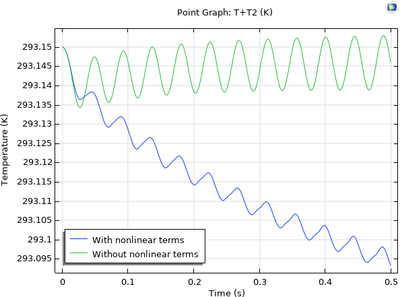
A thermoacoustic engine is a device with no moving parts that can generate acoustic energy from temperature gradients within the engine. It uses the relationship between the movement of oscillating air and the temperature changes in the air compressed and expanded by the acoustic waves. ... En savoir plus
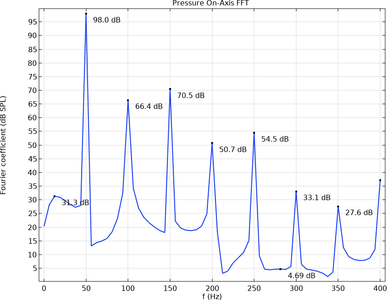
This model shows how to include the nonlinear (large signal) behavior of certain lumped components in a simplified loudspeaker analysis. The mechanical and electrical system is modeled using an equivalent electrical circuit. The large signal compliance CMS(x) and force factor BL(x) are ... En savoir plus


