
La Bibliothèque d'Applications présente des modèles construits avec COMSOL Multiphysics pour la simulation d'une grande variété d'applications, dans les domaines de l'électromagnétisme, de la mécanique des solides, de la mécanique des fluides et de la chimie. Vous pouvez télécharger ces modèles résolus avec leur documentation détaillée, comprenant les instructions de construction pas-à-pas, et vous en servir comme point de départ de votre travail de simulation. Utilisez l'outil de recherche rapide pour trouver les modèles et applications correspondant à votre domaine d'intérêt. Notez que de nombreux exemples présentés ici sont également accessibles via la Bibliothèques d'Applications intégrée au logiciel COMSOL Multiphysics® et disponible à partir du menu Fichier.
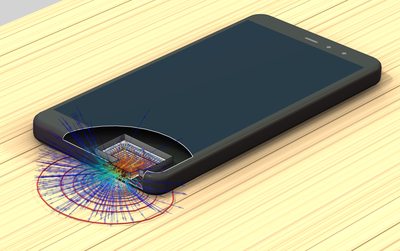
This tutorial model shows how to model a microspeaker located in a smart phone including the radiation through and interaction with the acoustic port that connects to the exterior. The model demonstrates a linear frequency domain analysis as well as a nonlinear time domain analysis. A ... En savoir plus
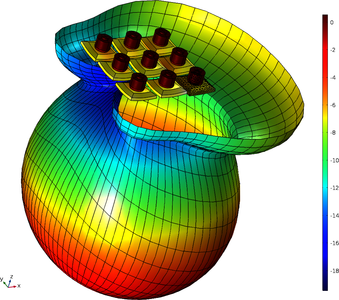
This model sets up a linear array of nine tonpilz piezoelectric transducers in a 3x3 grid. A voltage is applied that includes a phase change across the three rows. The transducers are located in a box below the sea surface. The exterior acoustics are modeled using the Pressure ... En savoir plus
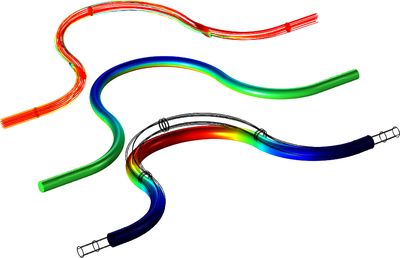
Coriolis flowmeters, also known as mass flowmeters or inertial flowmeters, measure the mass flow rate of a fluid traveling through it. It makes use of the fact that the fluid's inertia through an oscillating tube causes the tube to twist in proportion to the mass flow rate. Typically, ... En savoir plus
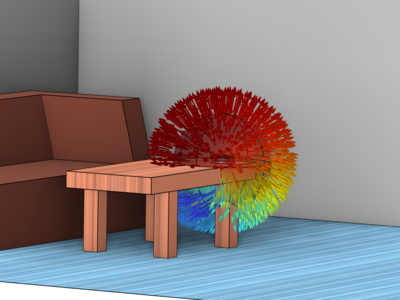
This model combines pressure acoustics and ray acoustics to perform a full frequency range analysis of the room impulse response of a small smart speaker. The source characterization in the ray tracing model is based on a full multiphysics model of the transducer and compares two source ... En savoir plus
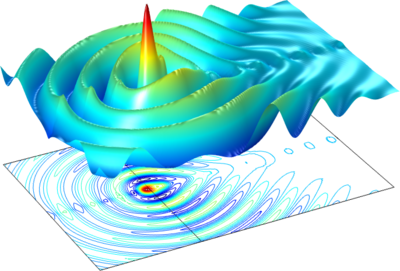
This is a benchmark model for the linearized Euler interface of the Acoustics Module. The model is from the NASA "Fourth Computational Aeroacoustics (CAA) Workshop on Benchmark Problems (2004)". The model results are compared to an analytical solution by Agarwal et al. (AIAA Vol. 42, No. ... En savoir plus
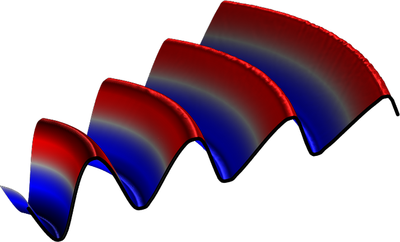
This model example shows how to model nonlinear propagation of a cylindrical wave using the Nonlinear Pressure Acoustics, Time Explicit physics interface available in Acoustics Module of COMSOL Multiphysics. The interface implements the system of nonlinear acoustic equations in the form ... En savoir plus

Acoustic streaming, a steady flow induced by sound waves, has been used in biomedical and engineering industrial., Examples include enhancement of convective heat transfer, ultrasonic cleaning, localized micro-mixing, hemolysis of blood cells, and micropumps etc. The phenomenon is ... En savoir plus

The models simulate the working mechanism of traveling wave thermoacoustic engines. Similary to the standing wave engines, the traveling wave engines make use of the coupling between the fluid motion and the temperature change experienced by the fluid to generate acoustic energy. ... En savoir plus


