
La Bibliothèque d'Applications présente des modèles construits avec COMSOL Multiphysics pour la simulation d'une grande variété d'applications, dans les domaines de l'électromagnétisme, de la mécanique des solides, de la mécanique des fluides et de la chimie. Vous pouvez télécharger ces modèles résolus avec leur documentation détaillée, comprenant les instructions de construction pas-à-pas, et vous en servir comme point de départ de votre travail de simulation. Utilisez l'outil de recherche rapide pour trouver les modèles et applications correspondant à votre domaine d'intérêt. Notez que de nombreux exemples présentés ici sont également accessibles via la Bibliothèques d'Applications intégrée au logiciel COMSOL Multiphysics® et disponible à partir du menu Fichier.
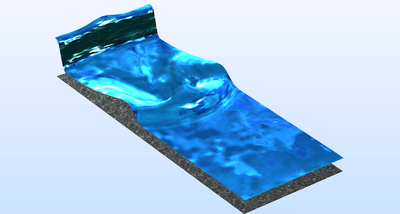
This example uses the Shallow Water equations to model the impact of a water wave on a column. A body of water with a height of 0.3 meters is initially contained behind a gate. At the start of the simulation, the gate is suddenly released and the body of water forms a wave moving toward ... En savoir plus
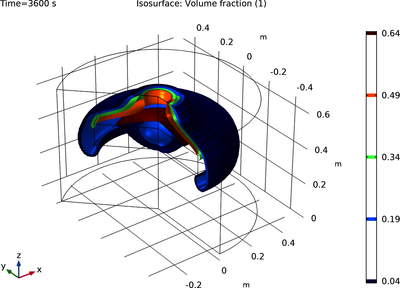
This example demonstrate two-phase flow in a porous medium which contains a low permeable lens. The heavier phase infiltrates the porous medium, so the low permeable lens is infiltrated only when a critical saturation at the outside is reached. En savoir plus
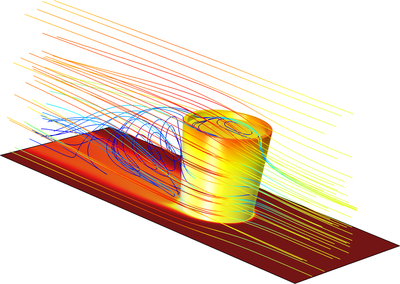
This tutorial shows how to couple three physics interfaces to model evaporative cooling. The effects that need to be taken into account are heat transfer, transport of water vapor, and fluid flow. The Wet Surface feature is used to implement the source term for the water vapor and to ... En savoir plus
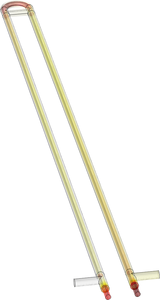
Double-pipe heat exchangers, with their typical U-turn shape, are one of the simplest and cheapest type of heat exchangers used in the chemical process industry. This example studies the cooling of hot oil (130°C) by a cool oil (60°C) entering in counter-current. As the oils flow ... En savoir plus
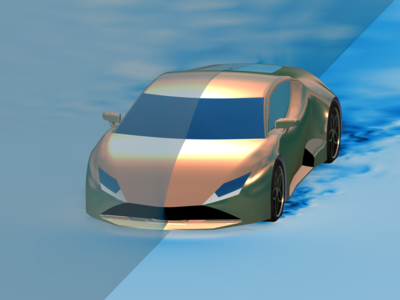
This example simulates turbulent flow around a sports car traveling at a speed of 180 km/h using Large Eddy Simulations (LES). En savoir plus
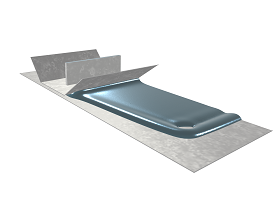
This is a tutorial of a slot die coating process in 3D where the channel is obstructed. The example uses a two-phase flow phase-field method with a non-Newtonian power-law fluid. The effects on the film thickness of the channel obstruction can clearly be seen. En savoir plus
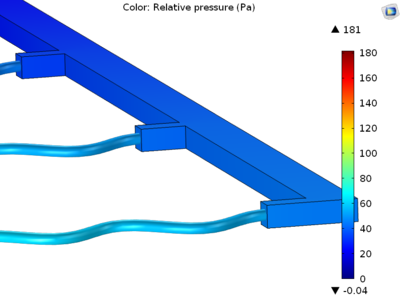
This example models flow in a microchannel heat exchanger by coupling a Laminar Flow interface in 3D to a Pipe Flow interface. By the use of the Pipe Flow interface to model the flow in the microchannels the problem size is significantly reduced. This model showcases the Pipe Connection ... En savoir plus
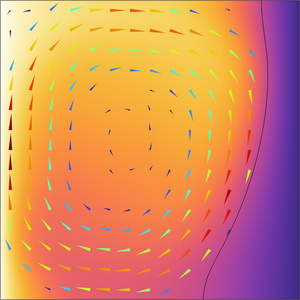
This example demonstrates how to model phase transition by a moving boundary interface according to the Stefan problem. A square cavity containing both solid and liquid tin is submitted to a temperature difference between left and right boundaries. Fluid and solid parts are solved in ... En savoir plus
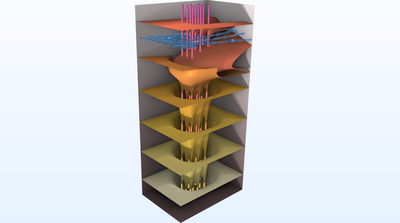
This model shows how to compute an array of borehole heat exchangers (BHEs) for shallow geothermal energy production. The BHEs are simplified as line heat sinks with a uniform heat extraction rate. The array is embedded into a layered subsurface model with groundwater flow in one of the ... En savoir plus
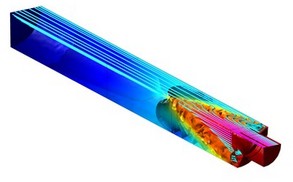
This example models the casting process of a metal rod from liquid to solid state using the Non-Isothermal Flow multiphysics interface, which combines heat transfer and fluid flow. The model describes the fluid and solid flow and heat transport, including the phase transfer from melt to ... En savoir plus


