
La Bibliothèque d'Applications présente des modèles construits avec COMSOL Multiphysics pour la simulation d'une grande variété d'applications, dans les domaines de l'électromagnétisme, de la mécanique des solides, de la mécanique des fluides et de la chimie. Vous pouvez télécharger ces modèles résolus avec leur documentation détaillée, comprenant les instructions de construction pas-à-pas, et vous en servir comme point de départ de votre travail de simulation. Utilisez l'outil de recherche rapide pour trouver les modèles et applications correspondant à votre domaine d'intérêt. Notez que de nombreux exemples présentés ici sont également accessibles via la Bibliothèques d'Applications intégrée au logiciel COMSOL Multiphysics® et disponible à partir du menu Fichier.
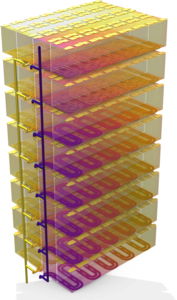
High-power battery energy storage systems (BESS) are often equipped with liquid-cooling systems to remove the heat generated by the batteries during operation. This tutorial demonstrates how to define and solve a high-fidelity model of a liquid-cooled BESS pack which consists of 8 ... En savoir plus
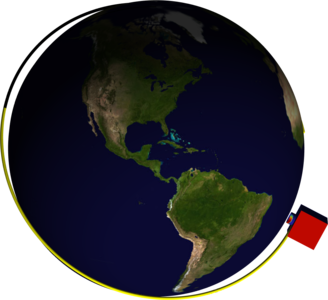
This model is an introduction to defining and verifying a satellite orbit, and computing the solar, albedo, and Earth infrared thermal loads. A 1U CubeSat is in a circular orbit at 400km altitude, inclination of 50°, and longitude of ascending node of 0°. The satellite is rotating slowly ... En savoir plus
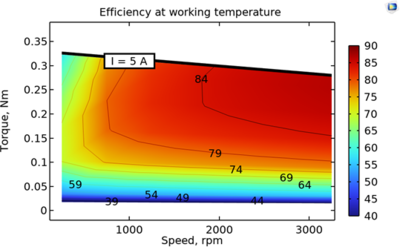
This a continuation of the permanent magnet motor model available here . In this model, an heat transfer analysis has been performed to compute the temperature rise for various stator current and rotor speed. A detailed analysis on torque, and losses in iron and copper have then been ... En savoir plus

The Czochralski (CZ) method is one of the most important methods for the preparation of monocrystalline silicon. The shape of the crystal, especially the diameter, is controlled by carefully adjusting the heating power, the pulling rate, and the rotation rate of the crystal. This model ... En savoir plus
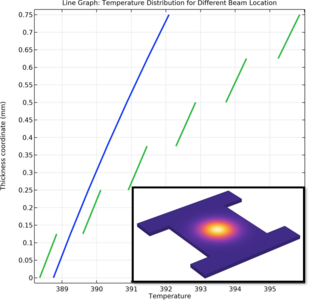
This example uses the thermal expansion of a laminated composite shell model to demonstrate the use of the feature Thermal Contact, Interface, applied on interfaces between layers in a laminated composite shell. The first study is computed neglecting this additional thermal resistance in ... En savoir plus
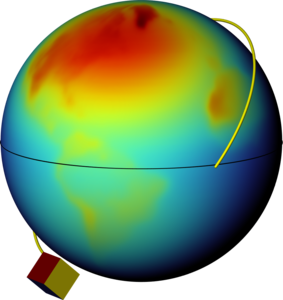
This model demonstrates how to define Earth properties that are spatially varying on the planet. A satellite in orbit experiences solar, albedo, and planetary infrared (IR) loads, where albedo and planetary IR can vary with latitude and longitude. In this example, these inputs are read ... En savoir plus
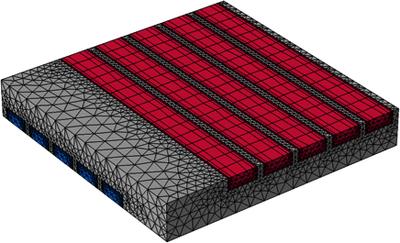
You can use assembly meshing to reduce the number of mesh elements in your model, which is especially useful for conjugate heat transfer simulation in cases where the fluid domains can be handled with swept mesh. These models demonstrate how to use form assembly and discontinuous meshes ... En savoir plus
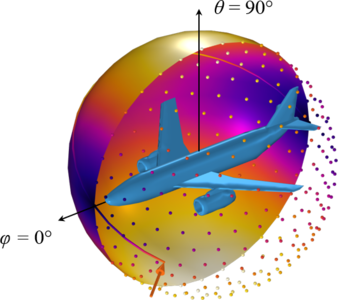
This model presents a way to compute projected area using the Surface-to-Surface Radiation interface of the Heat Transfer Module. By computing illuminated area from a set of directions on a discretized sphere, it is possible to interpolate the projected area onto any angle of incidence. ... En savoir plus
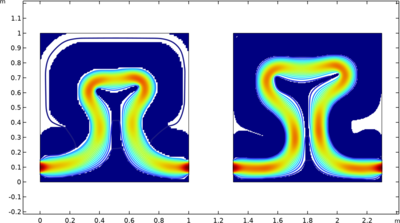
This model demonstrates topology optimization of a 2D heat exchanger with laminar flow. The flow is pressure driven and the objective is to maximize the heat transfer. The density method is used with the (now) classical approach of a single design variable and two flow interfaces. ... En savoir plus
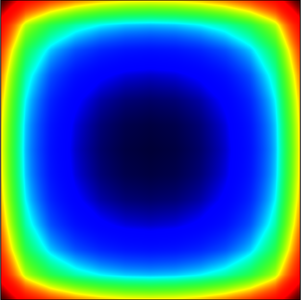
This model is used on "Heat Transfer with Radiation in Participating Media and the Discrete Ordinates Method" to compare quadrature sets used in the method of discrete ordinates. The reference analytical solution of incident irradiation is obtained with 256 discrete directions. Errors in ... En savoir plus


