
La Bibliothèque d'Applications présente des modèles construits avec COMSOL Multiphysics pour la simulation d'une grande variété d'applications, dans les domaines de l'électromagnétisme, de la mécanique des solides, de la mécanique des fluides et de la chimie. Vous pouvez télécharger ces modèles résolus avec leur documentation détaillée, comprenant les instructions de construction pas-à-pas, et vous en servir comme point de départ de votre travail de simulation. Utilisez l'outil de recherche rapide pour trouver les modèles et applications correspondant à votre domaine d'intérêt. Notez que de nombreux exemples présentés ici sont également accessibles via la Bibliothèques d'Applications intégrée au logiciel COMSOL Multiphysics® et disponible à partir du menu Fichier.

Chemical mechanical polishing (CMP) is a crucial technique for surface planarization, widely used in semiconductor fabrication and optical device manufacturing. This model approximates the flow field of the slurry using a turbulent single-phase flow model. The Frozen Rotor approach is ... En savoir plus
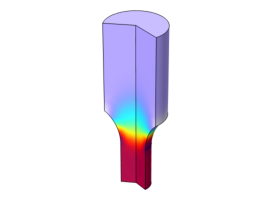
The model shows how to calibrate the probability distribution of the Young's modulus and Poisson ratio based on a tensile test. The test measures the tensile force and the radial displacement for different values of the prescribed displacement. The model is based on synthetic data ... En savoir plus
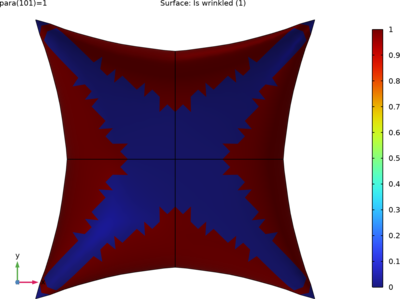
A square airbag is inflated using constant air pressure. In some regions of the airbag the material wrinkles during inflation, as negative principal stresses develop. The wrinkling membrane model within the tension field theory gives a correct description of the stress distribution and ... En savoir plus
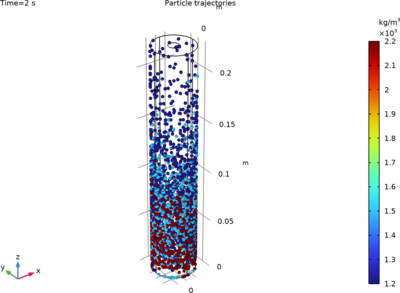
A tubular centrifuge is a type of centrifugal separation device that is often used for separation of very fine solid particles from a liquid. It can be run in both a continuous and batch type configurations. The device usually consists of a cylindrical rotating bowl with a large aspect ... En savoir plus
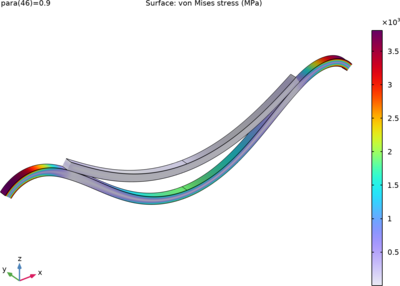
This conceptual example shows how to calculate critical points in models with contact. The model consists of two contacting arches modeled with the Shell interface. The contact problem is solved using the penalty method. The upper arch is loaded with displacement controlled edge loads ... En savoir plus
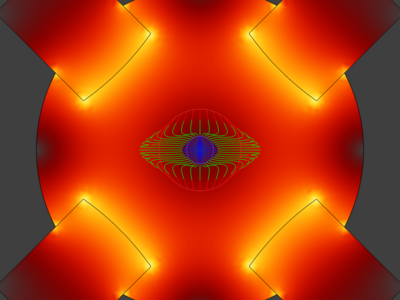
Just like optical lenses focus light, electric and magnetic lenses can be used for focusing beams of charged particles. This COMSOL Multiphysics model shows the path of B5+ ions passing through a focusing system of three magnetic quadrupoles. Each of the quadropoles focus the beam of ... En savoir plus
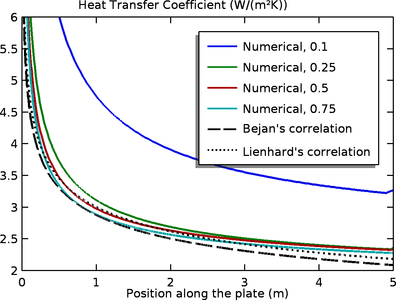
This verification model of nonisothermal turbulent flow over a flat plate compares the heat transfer coefficient obtained from simulation with theoretical values based on Nusselt number correlation functions that can be found in the literature. En savoir plus

As oil flows through a pipeline section heat is released due to the work of internal friction forces in the fluid. With good insulation of the pipeline, this generated heat can be used to avoid preheating of the oil, despite the fact that it is to be transported in a cold environment ... En savoir plus
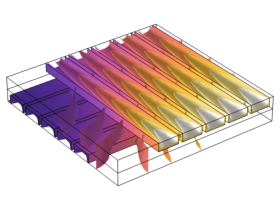
This model solves the fluid flow and heat transfer in a micro heat exchanger made of stainless steel. These types of heat exchangers are found in lab-on-chip devices in biotechnology and micro reactors, for example for micro fuel cells. The model takes heat transferred through both ... En savoir plus

In this tutorial, the eigenmodes and eigenfrequencies of an air bubble in water are modeled and compared with analytical solutions. The effects of surface tension are included, allowing both the pulsating mode and the surface modes of the bubble to be modeled. Lastly, the effect of the ... En savoir plus


