
La Bibliothèque d'Applications présente des modèles construits avec COMSOL Multiphysics pour la simulation d'une grande variété d'applications, dans les domaines de l'électromagnétisme, de la mécanique des solides, de la mécanique des fluides et de la chimie. Vous pouvez télécharger ces modèles résolus avec leur documentation détaillée, comprenant les instructions de construction pas-à-pas, et vous en servir comme point de départ de votre travail de simulation. Utilisez l'outil de recherche rapide pour trouver les modèles et applications correspondant à votre domaine d'intérêt. Notez que de nombreux exemples présentés ici sont également accessibles via la Bibliothèques d'Applications intégrée au logiciel COMSOL Multiphysics® et disponible à partir du menu Fichier.
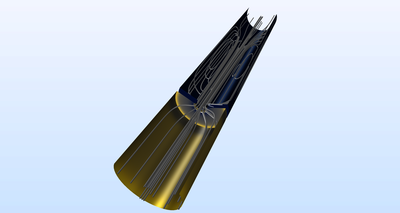
This example considers the turbulent flow of an oil-water suspension through an orifice. The oil droplets are broken up into smaller droplets by the turbulent stresses as the suspension passes through the orifice. The aim of this model is to track the distribution of droplet sizes. The ... En savoir plus

In this tutorial, the eigenmodes and eigenfrequencies of an air bubble in water are modeled and compared with analytical solutions. The effects of surface tension are included, allowing both the pulsating mode and the surface modes of the bubble to be modeled. Lastly, the effect of the ... En savoir plus
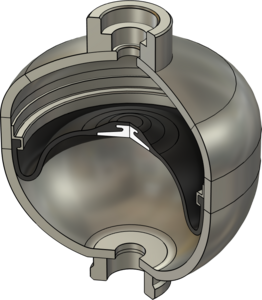
Diaphragm accumulators are essential components that store energy and regulate hydraulic systems. A flexible rubber diaphragm divides the hydraulic fluid from a compressible inert gas, typically nitrogen. These accumulators perform multiple tasks, such as temporarily storing hydraulic ... En savoir plus
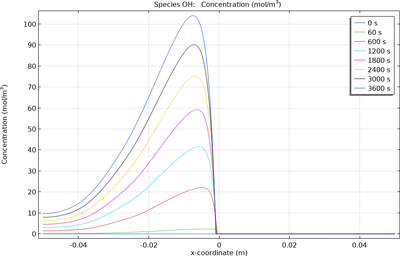
Atmospheric corrosion occurs when metallic structures are exposed to humid air forming a thin electrolyte film in the range of up to a few hundred micrometers. The model presented here accounts for charge transport as well mass transport involving 10 species and 6 homogeneous ... En savoir plus
The use of Aluminum (Al) isolator is a commonly employed mitigation strategy for galvanic corrosion between magnesium alloy (Mg) and mild steel (MS). The present model demonstrates the effect of Al isolator thickness on galvanic corrosion severity using a parametric study. The electrode ... En savoir plus
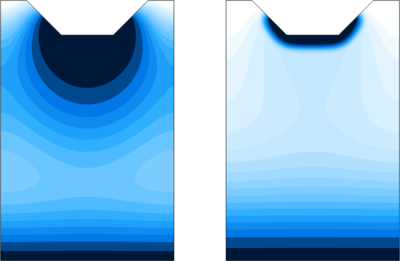
This example shows how to set up a model of furrow irrigation in a nonuniform soil column. It employs the Unsaturated Dual Permeability feature, which links two Richards' Equations through a fluid transfer function. This scenario can be regarded as a benchmark problem for dual ... En savoir plus
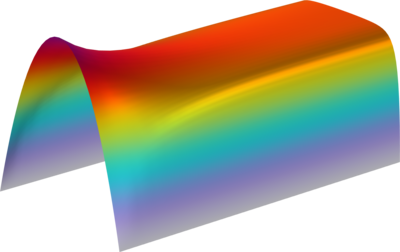
Classical MHD benchmark problem was solved analytically by J. Hartmann. He considered laminar incompressible flow between two planes (in planar duct) in transversal imposed magnetic field under next assumptions: * fully developed flow (far from inlet) * fluid properties are constant * ... En savoir plus
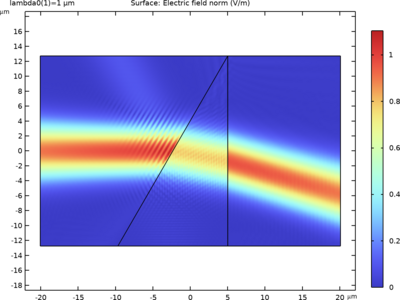
This model illustrates the refraction of light while passing through an optical prism using s– and p–polarized incident Gaussian beams. The prism boundaries are coated with anti–reflection coatings. It also calculates the reflectance and transmittance to analyze the performance of anti ... En savoir plus
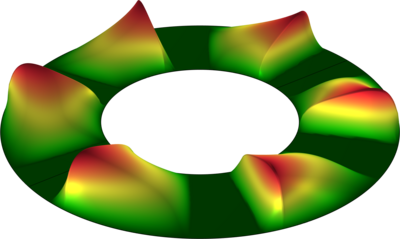
In this tutorial model, a six-step thrust bearing is analyzed. A step thrust bearing consists of a stepped bearing surface on which the end of the shaft rotates. The entire assembly is submerged in a lubricant. The shaft collar is assumed to rotate without any axial motion in the ... En savoir plus
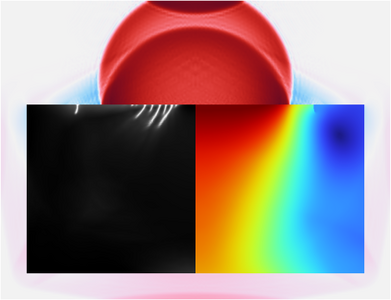
An acoustic point source emits a pressure wave in water that travels toward a piece of glass. Cracks are formed and propagate due to high tensile stresses developed in the glass. A fully coupled acoustic-structure interaction problem including phase field damage in solids is solved in ... En savoir plus


