
La Bibliothèque d'Applications présente des modèles construits avec COMSOL Multiphysics pour la simulation d'une grande variété d'applications, dans les domaines de l'électromagnétisme, de la mécanique des solides, de la mécanique des fluides et de la chimie. Vous pouvez télécharger ces modèles résolus avec leur documentation détaillée, comprenant les instructions de construction pas-à-pas, et vous en servir comme point de départ de votre travail de simulation. Utilisez l'outil de recherche rapide pour trouver les modèles et applications correspondant à votre domaine d'intérêt. Notez que de nombreux exemples présentés ici sont également accessibles via la Bibliothèques d'Applications intégrée au logiciel COMSOL Multiphysics® et disponible à partir du menu Fichier.
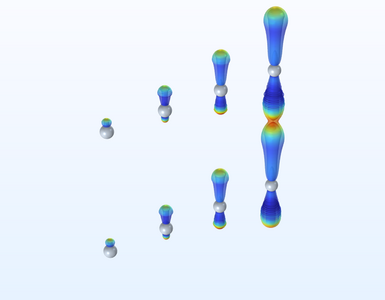
This model simulates the initiation of streamers from suspended metal particles, their propagation under a high electric field, and their subsequent merging. The discharge current flows into the metal particles, which are maintained at equal potential. These suspended particles enhance ... En savoir plus
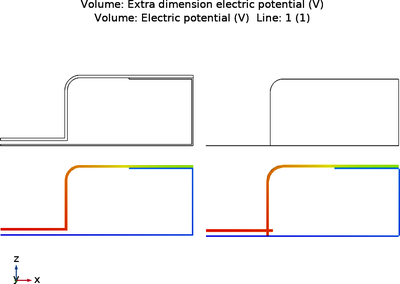
This example demonstrates a benchmark test showing that Electric Currents in Layered Shells physics interface can be used to obtain the same results as when the model is solved with the Electric Currents interface based on a solid 3D structure. En savoir plus
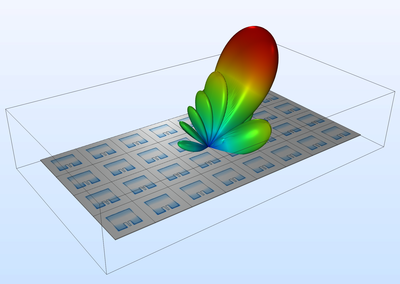
The demand for phased array antennas increases not only for the traditional military industry but also in commercial areas such 5G mobile network platforms, Internet of Things (IoT), and satellite communication applications. This example shows how to design a phased array with a beam ... En savoir plus
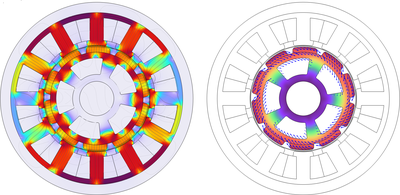
In this example, the coupling between Multibody Dynamics and Rotating Machinery, Magnetic for performing electromagnetic and mechanical analysis is demonstrated. A permanent magnet motor with 10 rotor poles and 12 stator slots is modelled in 2D. The magnets are attached to the ... En savoir plus
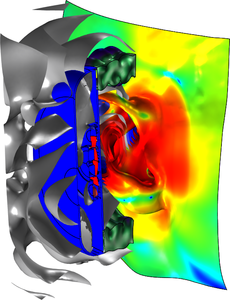
Headphones are closely coupled to the ear, and so it is not possible to measure their sensitivity in a classical acoustic free-field setup used for loudspeakers. The measurement requires the use of artificial heads and ears to accurately represent the usage conditions. This model shows ... En savoir plus
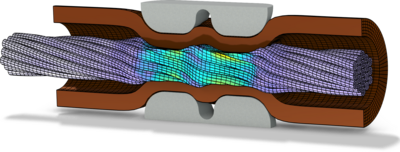
Crimping is the plastic deformation process used to form an electrical joint between a stranded conductor and a terminal. The process involves complex multi-surface contact, including self-contact, as the terminal sleeve is plastically deformed around the wire strands. This example ... En savoir plus
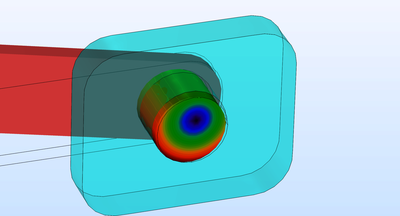
Joints between two components of a mechanical system are sometimes not perfectly fitting. For the ease of assembly and to allow relative movement between the components, a small gap called clearance is provided between the joining components. The presence of clearance on joints can ... En savoir plus
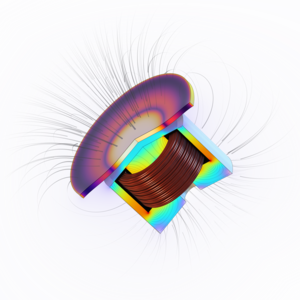
A magnetic diaphragm is a flexible, thin structure that interacts with magnetic fields to perform mechanical or sensing functions. When subjected to an external magnetic field, the diaphragm deforms due to magnetomechanical interactions, converting magnetic energy into mechanical ... En savoir plus
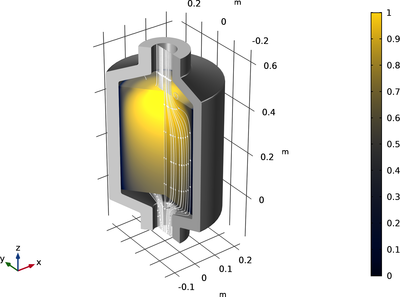
Thermal energy storage units are used to accumulate thermal energy from solar, geothermal, or waste heat sources. The simplest units are built from water tanks, often found in households, where the solar energy is stored as sensible heat. The thermal capacity of these tanks can be ... En savoir plus
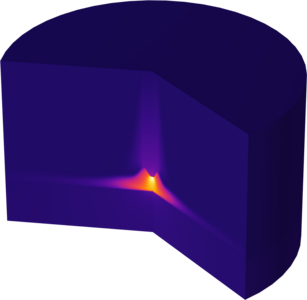
This example investigates the electrical and thermal characteristics of a welding argon arc created in a point-to-plane configuration. The discharge is assumed to be in local thermodynamic equilibrium. The electric arc is considered a conductive fluid medium and is modeled using a ... En savoir plus


