
La Bibliothèque d'Applications présente des modèles construits avec COMSOL Multiphysics pour la simulation d'une grande variété d'applications, dans les domaines de l'électromagnétisme, de la mécanique des solides, de la mécanique des fluides et de la chimie. Vous pouvez télécharger ces modèles résolus avec leur documentation détaillée, comprenant les instructions de construction pas-à-pas, et vous en servir comme point de départ de votre travail de simulation. Utilisez l'outil de recherche rapide pour trouver les modèles et applications correspondant à votre domaine d'intérêt. Notez que de nombreux exemples présentés ici sont également accessibles via la Bibliothèques d'Applications intégrée au logiciel COMSOL Multiphysics® et disponible à partir du menu Fichier.
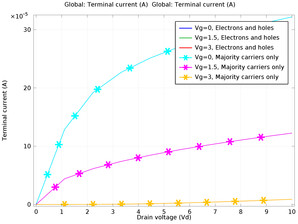
In a MESFET, the gate forms a rectifying junction that controls the opening of the channel by varying the depletion width of the junction. In this model we simulate the response of a n-doped GaAs MESFET to different drain and gate voltages. For a n-doped material the electron ... En savoir plus
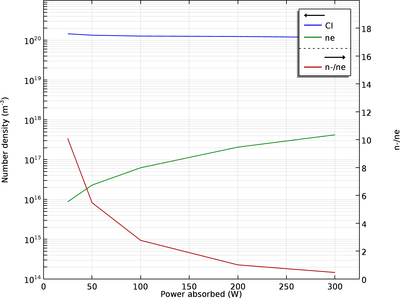
Plasma discharges containing chlorine are commonly used to etch semiconductors and metals in microelectronics fabrication. This tutorial model studies chlorine plasma discharges using a global (volume-averaged) diffusion model. Global diffusion models can run simulations in a fraction ... En savoir plus
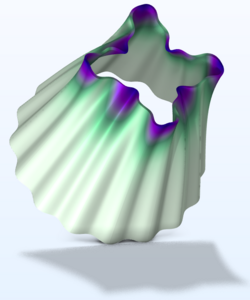
This example illustrates a linear buckling analysis conducted for a corrugated conical shell, utilizing a single sector of the geometry along with cyclic symmetry periodicity edge conditions. The results are compared to those using the full shell geometry. En savoir plus
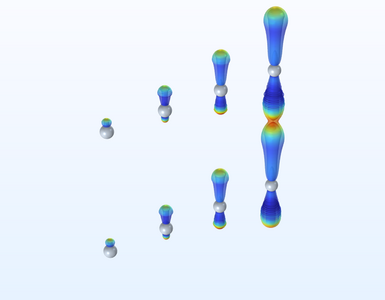
This model simulates the initiation of streamers from suspended metal particles, their propagation under a high electric field, and their subsequent merging. The discharge current flows into the metal particles, which are maintained at equal potential. These suspended particles enhance ... En savoir plus
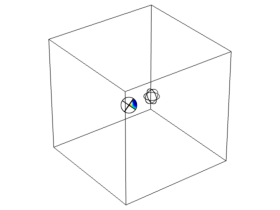
This model verifies that the onset of streamer formation between two spheres separated by atmospheric pressure dry air at a distance of 2cm occurs at 51.8kV. The electrical breakdown is detected by integrating Townsend coefficients along the electric field lines between the two spheres. ... En savoir plus

This example shows how to implement a stress dependent material model. The Young's modulus changes based on the stress value. En savoir plus
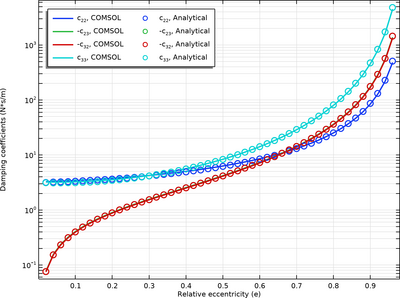
Squeeze film dampers are components that provide additional damping to rotating machines. To simplify the modeling of a rotor assembly, squeeze film dampers are modeled in terms of their damping coefficients which are a functions of the journal location in the damper. This model computes ... En savoir plus
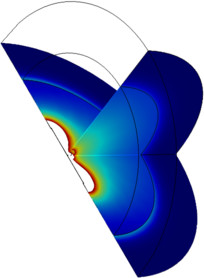
Feeding antennas with proper signals can be difficult. The signal is often described as a voltage, and voltages are not well defined in electromagnetic wave formulations. There are several tricks to model voltage generators in such situations, and one is the magnetic frill. This model ... En savoir plus
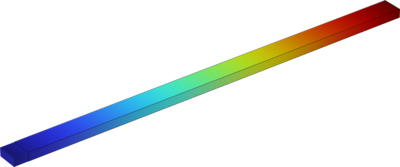
The elastoacoustic effect is a change in the speed of elastic waves that propagate in a structure undergoing static elastic deformations. The effect is used in many ultrasonic techniques for nondestructive testing of prestressed states within structures. This example studies the ... En savoir plus
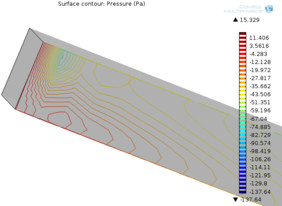
A lab-on-a-chip platform can be realized on a rotating disc by designing channels and other features to use the Coriolis or centrifugal forces to manipulate the flow. These forces are controlled by changing the angular velocity of the disc, so the platform is programmed by using a ... En savoir plus


