
La Bibliothèque d'Applications présente des modèles construits avec COMSOL Multiphysics pour la simulation d'une grande variété d'applications, dans les domaines de l'électromagnétisme, de la mécanique des solides, de la mécanique des fluides et de la chimie. Vous pouvez télécharger ces modèles résolus avec leur documentation détaillée, comprenant les instructions de construction pas-à-pas, et vous en servir comme point de départ de votre travail de simulation. Utilisez l'outil de recherche rapide pour trouver les modèles et applications correspondant à votre domaine d'intérêt. Notez que de nombreux exemples présentés ici sont également accessibles via la Bibliothèques d'Applications intégrée au logiciel COMSOL Multiphysics® et disponible à partir du menu Fichier.
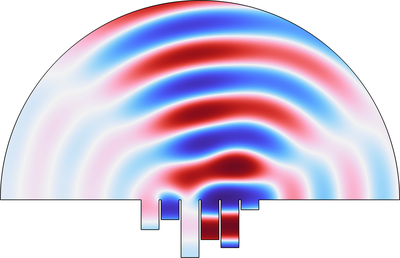
In this model, the scattering coefficient of a Schroeder diffuser is calculated. This coefficient can then be used as input to express boundary conditions in typical room acoustic simulations. The effect of periodicity is also investigated by studying the responses from different ... En savoir plus
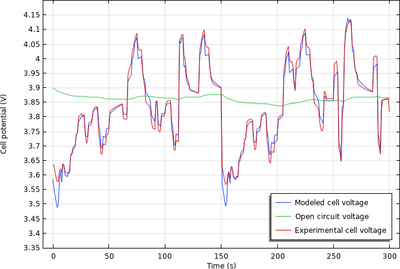
This tutorial uses an equivalent circuit approach for modeling the performance of a lithium-ion battery, requiring no knowledge about the internal chemistry or structure of the battery. A 0D equivalent circuit battery model is defined based on a resistor connected in series with a ... En savoir plus

This model showcases how to use fibers in thin layers to model thin anisotropic composites embedded in a solid without explicitly drawing either the layer of material or the reinforcing fibers. Here, it is used to model steel cords in tire belts that are used to provide structural ... En savoir plus

These models are featured in the blog post Analyze Violin Tone and Volume with Multiphysics Modeling. One applies acoustic-structure interaction to study how the air mode resonance is affected by the coupled vibrations in the violin body. The other uses a potential flow approximation to ... En savoir plus
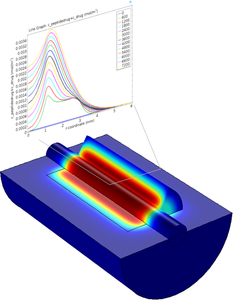
In this example, drug-release from a biomaterial matrix to damaged cell tissue is modeled. Specifically, a nerve guide delivers a regenerating drug to damaged nerve ends. The model involves detailed drug release kinetics, with rate expressions handling drug dissociation/association ... En savoir plus
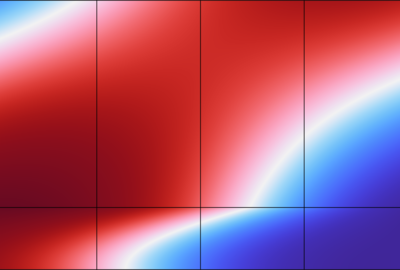
This tutorial investigates the acoustic properties of a porous layer made of glass wool. The porous material has transverse isotropic properties and is modeled with the full anisotropic poroelastic material model. En savoir plus
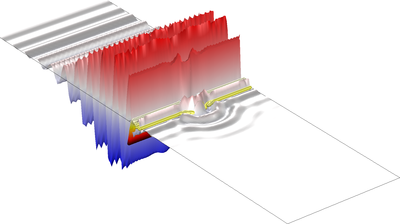
This tutorial shows how to solve the full time-dependent wave equation in dispersive media such as plasmas and semiconductors. The 2D TM in-plane wave model solves for the vector potential from the wave equation and for an auxiliary electric polarization density from an ordinary ... En savoir plus
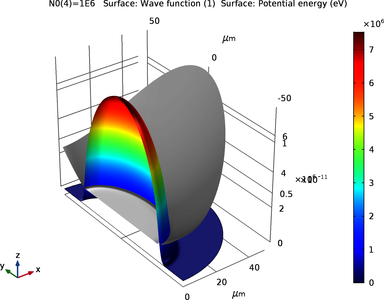
This tutorial model solves the Gross–Pitaevskii Equation for the ground state of a Bose–Einstein condensate in a harmonic trap, using the Schrödinger Equation interface in the Semiconductor Module. The equation is essentially a nonlinear single-particle Schrödinger Equation, with a ... En savoir plus
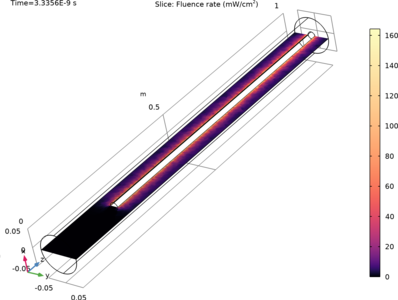
This model demonstrates how to compute the volumetric fluence rate in an ultraviolet (UV) reactor. The geometry is the annular fluid region surrounding a cylindrical lamp. The effect of reflection at the reactor walls on the radial fluence rate distribution is considered. En savoir plus

The Hubble Space Telescope (HST) is an example of a standard Cassegrain telescope. The Conic Mirror On Axis 3D part from the COMSOL part library is used to construct the HST Ritchey-Chretien geometry. Multiple release features are used to generate on and off-axis ray and spot diagrams. En savoir plus


